

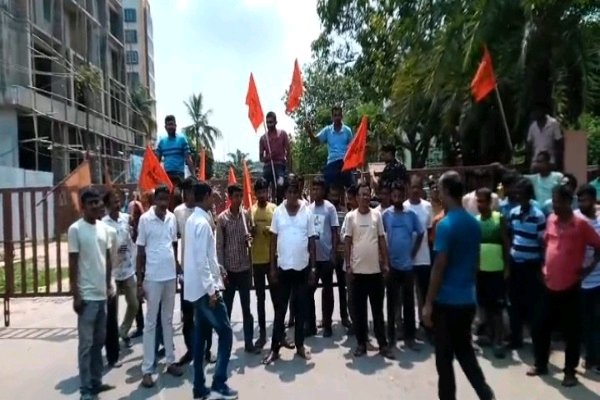
A violent clash between rival transport worker groups at Nagerjala Motor Stand in Agartala on June 3 has triggered political debate in Tripura.
The incident left several people injured and exposed internal tensions among grassroots stakeholders, presenting an early leadership challenge for the newly appointed BJP state president.
Quick Glance
- Several transport workers sustained injuries during clashes at Nagerjala Motor Stand.
- Rival groups traded allegations following a protest over operational and infrastructure issues.
- The controversy has highlighted factional tensions within sections of the BJP-linked grassroots ecosystem.
- Political observers view the incident as an early organizational challenge for the new BJP state leadership.
Agartala: The clash at Nagerjala Motor Stand on Wednesday has generated concern far beyond the transport sector. While the immediate issue involved a confrontation between rival groups of transport workers, the political implications have quickly come into focus.
Several people reportedly suffered injuries after tensions escalated during a protest concerning infrastructure and operational challenges at the motor stand. What began as a demonstration soon transformed into a public dispute marked by serious allegations and counter-allegations.
The incident occurred at one of Tripura’s most important transportation hubs. As a result, the developments have attracted attention from political circles, transport operators, and the general public alike.
Allegations and Counter-Allegations Intensify Controversy
Transport union leader Litan Kar alleged that he came under attack while participating in the protest. He further accused local corporator Abhijit Mallik of involvement in the incident.
However, Mallik categorically rejected the allegations. He described the claims as baseless and questioned Kar’s conduct and background.
The exchange has intensified public interest in the dispute. More importantly, it has shifted attention toward underlying divisions among groups operating within the transport ecosystem.
At present, police have not issued a detailed official statement regarding the incident. Investigations are expected to determine the sequence of events that led to the violence.
Internal Divisions Come Under Spotlight
Political observers believe the clash has revealed deeper tensions that may have existed for some time at the grassroots level.
According to analysts, disagreements involving local leaders, worker organizations, and affiliated groups often remain confined to internal discussions. However, when such disputes spill into public spaces, they can affect both organizational stability and public perception.
The Nagerjala episode appears to have crossed that threshold.
Observers note that the controversy is no longer being viewed solely as a labour dispute. Instead, it is increasingly being discussed as a test of conflict management and organizational discipline.
Early Leadership Challenge for New BJP State President
The timing of the incident has amplified its significance.
Tripura BJP recently entered a new organizational phase under fresh leadership. Expectations remain high that the newly appointed state president will not only strengthen the party structure but also address emerging internal challenges.
Political commentators argue that maintaining unity among diverse stakeholder groups remains one of the most critical responsibilities for any state-level leadership.
The Nagerjala clash has therefore emerged as an early leadership test.
Experts suggest that resolving disputes before they escalate into public confrontations will be crucial for maintaining organizational cohesion. They also believe the leadership may need to facilitate dialogue between rival groups and address the root causes behind recurring disagreements.
Why Nagerjala Motor Stand Matters
Nagerjala Motor Stand serves as a key transport hub connecting Agartala with multiple destinations across Tripura and neighboring regions.
Its strategic importance means that any disruption can affect commuters, transport operators, and commercial activities.
The stand involves several stakeholders, including transport workers, unions, administrators, and local authorities. Consequently, disagreements regarding operations, representation, and administration often attract wider public attention.
The latest clash has renewed calls for stronger mechanisms to resolve disputes before they escalate into violence.
Political Implications May Extend Beyond the Motor Stand
Political analysts believe incidents involving individuals linked to the same broader political ecosystem often carry consequences beyond the immediate dispute.
Such developments can create perceptions of internal divisions. They can also provide opposition parties with opportunities to question organizational unity.
For this reason, many observers expect senior leaders to closely monitor the developments arising from the Nagerjala incident.
The ability to ensure accountability while preserving unity may become a defining factor in how the issue is ultimately resolved.
Looking Ahead
As investigations continue, attention is gradually shifting from the immediate violence to the broader questions of leadership, organizational discipline, and conflict resolution.
The Nagerjala Motor Stand clash is not just about the violence that occurred but also it has raised questions about the organizational discipline.
For the BJP’s new state leadership, the coming days could offer an important opportunity to demonstrate its ability to manage internal differences, maintain unity, and prevent future disputes from escalating into public controversies.