

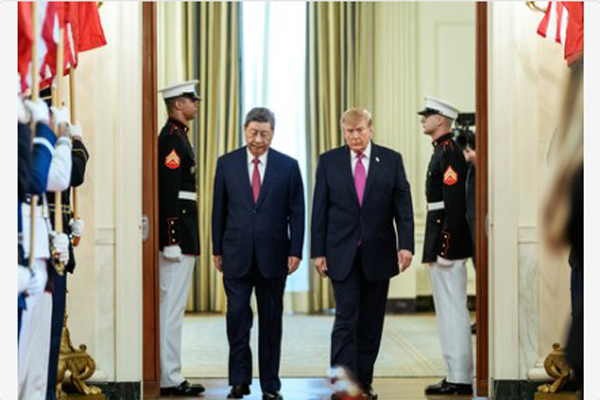
US President Donald Trump will meet Chinese President Xi Jinping in Shenzhen on November 19 to address bilateral economic and strategic concerns, amid disagreements within Washington over technology restrictions, AI safety and critical-mineral supplies, through high-level diplomatic discussions aimed at managing competition while preserving economic cooperation.
At A Glance
-
Divisions within Trump’s administration have emerged over restrictions on China’s access to advanced AI chips and computing technology.
-
Washington and Beijing are exploring cooperation on AI safety while attempting to preserve their trade truce.
-
Rare-earth supply concerns and India’s manufacturing ambitions add economic and strategic significance to the Shenzhen meeting.
Differences within the Trump administration over restricting China’s access to advanced technology have emerged as a major challenge ahead of President Donald Trump’s meeting with Chinese President Xi Jinping in Shenzhen on Thursday (November 19). The discussions will also test whether Washington and Beijing can maintain their trade truce while addressing artificial intelligence risks and critical-mineral supply concerns.
|Read More International News HERE |
The November 19 meeting comes amid competing approaches within the US administration towards China. While several senior officials favour tighter technology restrictions, some have advocated a more flexible approach. Meanwhile, both countries are exploring cooperation on AI safety despite their broader strategic rivalry.
US officials divided over restrictions on China
The New York Times reported that disagreements over China’s access to advanced technology extend beyond Treasury Secretary Scott Bessent and Commerce Secretary Howard Lutnick.
Secretary of State Marco Rubio, US Trade Representative Jamieson Greer and several National Security Council officials support broader restrictions on China’s access to advanced AI chips. However, Lutnick has favoured a softer approach, according to the newspaper’s account of discussions with current and former officials.
Supporters of a tougher China policy are also concerned that Trump might reverse recently announced restrictions or use them as bargaining leverage during negotiations with Xi.
Former National Security Adviser H.R. McMaster warned that Trump’s confidence in his negotiating abilities could undermine a consistent approach towards Beijing. He suggested that the President’s belief in his ability to secure exceptional deals could sometimes become an obstacle.
The administration announced fresh restrictions on Monday. These measures aim to prevent Chinese companies from remotely accessing advanced American computing technology through overseas data centres.
Washington and Beijing explore AI safety cooperation
Despite disagreements over technology access, the two governments are pursuing parallel efforts to manage artificial intelligence risks.
The Washington Post highlighted discussions on cooperation in testing advanced AI models and establishing a direct incident-notification mechanism.
Bessent said Washington and Beijing had started a dialogue to reduce shared risks and prevent misunderstandings. The proposed cooperation includes exchanging methods for evaluating advanced AI models before their release.
The two sides are also considering a direct communication channel to alert each other about serious incidents involving their respective AI models.
Bessent described the administration’s broader economic strategy as reducing vulnerabilities rather than completely ending economic relations with China.
This approach reflects Washington’s attempt to balance national security concerns with the economic consequences of severing commercial ties.
Rare-earth supplies add another dimension
Critical minerals represent another major challenge in the US-China relationship. Recent trade figures indicate the extent of American dependence on Chinese supplies.
A November 10 analysis by the Center for Strategic and International Studies found that US imports of specified rare-earth compounds and metals from China averaged 19.3 metric tonnes monthly between November 2025 and September 2026.
The monthly average was 76.8 metric tonnes before Beijing introduced restrictions in April 2025. This represents a decline of approximately 75 per cent.
The figures underline the potential consequences of supply-chain disruptions for industries dependent on rare-earth materials.
India’s manufacturing ambitions at stake
The issue has particular relevance for India, which also relies heavily on China for permanent magnets.
An Indian government background paper published in December 2025 showed that China accounted for between 84.8 per cent and 90.4 per cent of India’s permanent-magnet imports by quantity during the 2022-23 to 2024-25 financial years.
India has approved a Rs 7,280 crore scheme to establish domestic manufacturing capacity of 6,000 metric tonnes annually for sintered rare-earth permanent magnets.
These materials are essential for electric vehicles, renewable energy, electronics, aerospace and defence. Developing domestic production capacity could help India reduce its dependence on overseas supplies.
Quad meeting adds strategic significance
Trump’s engagement with regional partners also adds a geopolitical dimension to his forthcoming discussions with Xi.
At a November 9 briefing, CSIS senior adviser and Freeman Chair in China Studies Edgard Kagan said holding a Quad meeting before Trump’s China engagement would remind Beijing of Washington’s extensive regional partnerships.
Quad leaders met in Manila on Tuesday. Their discussions covered Iran, safe navigation and energy security. They also reaffirmed cooperation on critical-mineral supply chains.
The Shenzhen meeting will therefore bring together several interconnected challenges. Washington and Beijing must navigate disagreements over advanced technology while managing economic dependence and emerging AI risks. The outcome could also have implications for regional partnerships and countries such as India that are seeking more resilient critical-mineral supply chains. (Edited By Enewstime Desk)