

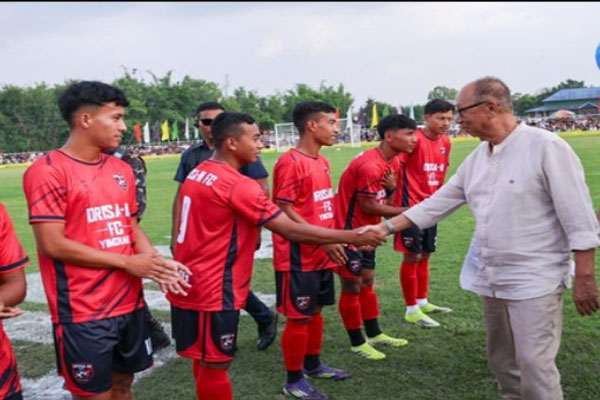
Manipur Chief Minister Yumnam Khemchand Singh sanctioned an immediate financial grant to preserve the state’s ancient traditional sport, Kang, while celebrating its power to bridge communal divides. Speaking at the closing ceremony of the 13th Chief Minister Trophy Kang Tournament in Imphal, Singh emphasized that grassroots athletics offer a powerful path toward long-term peace, social harmony, and cultural restoration across the state’s diverse communities.
Quick Glance: Key Cultural & Structural Takeaways
-
Ancestral Preservation: The state government actively promotes the ancient game of Kang, dating back to King Loitongba’s historical reign, to protect local cultural heritage.
-
Grassroots Funding Injection: Chief Minister Singh sanctioned a ₹1 Lakh grant directly from his executive account to support local tournament organizers.
-
2026 Infrastructure Deadline: Officials expect the National Sports University in Imphal to complete all physical infrastructure projects within the current calendar year.
Agartala/Imphal: According to our on-the-ground report in Imphal, the final match drew diverse crowds to the Manipur Kangshang venue within the Khuman Lampak Sports Complex. This tournament represents more than just athletic competition; it provides a vital link to the state’s shared history. Introduced centuries ago during the reign of King Loitongba, the game remains an anchor for local identity.
                  [Ancient Roots: Reign of King Loitongba]
                                     │
                                     ▼
               [Modern Revival: Inception by CM Singh in 1999]
                                     │
                                     ▼
         [2026 Milestones: 13th Edition & National Sports University]
Speaking exclusively to Enewstime Desk, local organizers confirmed that community collaboration sustains the tournament structure. The late former Chief Minister Wahengbam Nipamacha Singh established the modern iteration of the event in 1999 specifically to protect Manipur indigenous sports from globalized athletic formats.
Furthermore, the continuous support from the Manipur Kang Association ensures that younger generations retain a tangible connection to their ancestral heritage, reinforcing a collective sense of pride and belonging.
Modern Infrastructure Meets Community Aspirations
An internal document reviewed by Enewstime highlights a coordinated plan to tie cultural sports preservation with major national infrastructure projects. Prime Minister Narendra Modi originally championed this strategy by gifting the state India’s first National Sports University (NSU).
| Project / Initiative | Key Administrative Body | Project Objective & Impact | Funding / Timeline |
| CM Trophy Kang Tournament | Manipur Kang Association | Preserving ancient indigenous games among youth | ₹1 Lakh Immediate Grant |
| National Sports University | Central & State Government | Creating a premier hub for elite and grassroots athletes | Completion within 2026 |
| Khuman Lampak Upgrades | Dept. of Sports & Youth Affairs | Modernizing local venues to host regional events | Active Phase in 2026 |
Chief Minister Singh confirmed that the university’s comprehensive infrastructure works have entered their final phases. Consequently, the state expects the facility to become fully operational by the end of 2026. This development provides a permanent training ground where local youth can transition from traditional, community-based sports to international athletic platforms.
Community Calls for Peace and Togetherness
The closing ceremony drew widespread participation from community leaders and state officials alike. Notable attendees included Home Minister Konthoujam Govindas Singh, alongside MLAs Karam Shyam Singh, Sagolshem Kebi Devi, and Sapam Nishikant Singh. The presence of sports icons like former India football captain P. Renedy Singh and Lourembam Lolendra Singh further elevated the event.
In addition, administrative leaders like Sports Secretary Naorem Praveen Singh and YAS Director Dr. Mayengbam Veto Singh joined the closing ceremonies. The audience filled the venue with spontaneous slogans calling for peace and harmony across communities. Chief Minister Singh noted that these grassroots expressions reflect an authentic, widespread desire for social unity throughout Manipur.
To turn this momentum into tangible support, the executive desk’s ₹1 Lakh contribution will directly fund rural outreach programs. This ensures that Manipur indigenous sports continue to serve as safe spaces for dialogue, healing, and cultural unity.
Football Fans Perspective: Can Manipur Indigenous Sports Heal Communal Divides?
From a grassroots advocacy perspective, using traditional sports like Kang as a vehicle for peace hits on a vital truth: true social healing cannot simply emerge from ministerial offices in New Delhi or Imphal; it must grow organically within local communities.
When diverse youth compete together on the field at Khuman Lampak, artificial barriers begin to dissolve. Traditional games carry shared stories that predate modern political and ethnic frictions. By directly funding these events and completing the National Sports University in 2026, the administration provides local youth with positive, constructive spaces to connect.
However, social advocates emphasize that infrastructure alone does not guarantee a cure-all. For these initiatives to build lasting peace, the state must ensure equitable access to these sports facilities for marginalized and remote rural communities, turning athletic spaces into true centers for social justice, open dialogue, and long-term reconciliation.
