

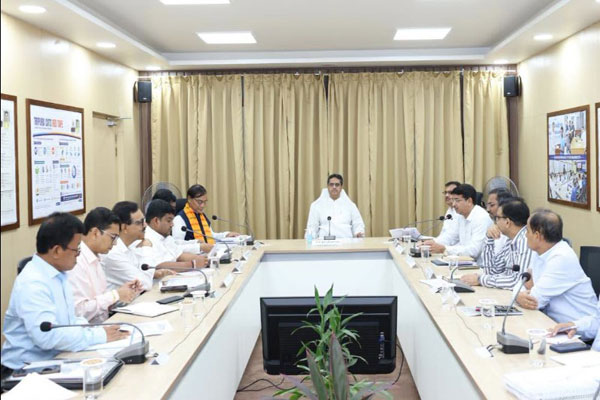
Tripura Government has intensified efforts to reduce dependence on groundwater by advancing the proposed Tripura Water Grid Project. During a high-level review meeting in Agartala on June 24, 2026, Chief Minister Dr Manik Saha directed officials to pursue a long-term river-based drinking water strategy, with the Gomati River emerging as the primary source for the first phase of the project.
Quick Glance: Key Takeaways
- Tripura plans to utilize surplus water from 12 rivers under the proposed Water Grid.
- Agartala currently receives a significant portion of its drinking water from groundwater sources.
- Existing infrastructure has a total design capacity of 107.82 MLD, but operational output stands at 88.49 MLD.
- Surface water currently contributes only 29 MLD, highlighting heavy groundwater dependence.
- The first phase will supply water to Agartala, Udaipur, Bishramganj and Bishalgarh.
Agartala: Tripura’s proposed Water Grid Project has gained momentum as the state seeks a permanent solution to mounting pressure on groundwater resources.
Chief Minister Dr Manik Saha chaired a high-level review meeting and stressed the need for a mission-mode approach to secure the state’s future drinking water requirements.
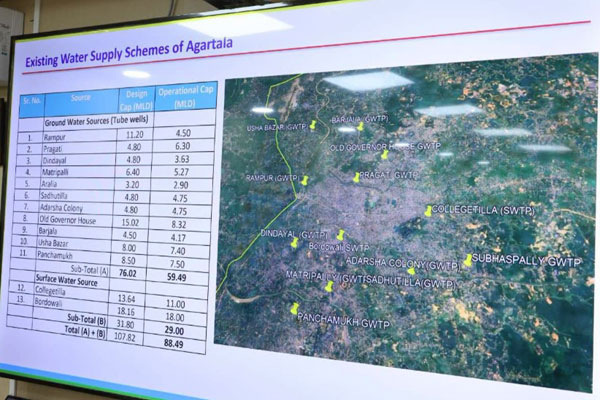
Officials presented data in the meeting that showed Agartala’s water supply system remains heavily dependent on tube wells and groundwater extraction.
The presentation highlighted that the city currently operates 11 groundwater-based water supply schemes. These include major installations at Rampur, Pragati, Dinadayal, Matripalli, Aralia, Sadhutilla, Adarsha Colony, Old Governor House, Barjala, Usha Bazar and Panchamukh.
The data reveals a growing challenge. While groundwater-based schemes have a combined design capacity of 76.02 million litres per day (MLD), they currently produce 59.49 MLD.
In contrast, Agartala’s two surface-water-based systems—College Tilla and Bordowali—have a combined operational capacity of only 29 MLD.
Existing Water Supply Infrastructure at a Glance
The figures presented during the review meeting indicate why the state is shifting towards a river-based water supply model.
| Source Category | Design Capacity (MLD) | Operational Capacity (MLD) |
|---|---|---|
| Groundwater Sources (11 schemes) | 76.02 | 59.49 |
| Surface Water Sources (2 schemes) | 31.80 | 29.00 |
| Total | 107.82 | 88.49 |
Among groundwater schemes, the Old Governor House facility has the highest design capacity at 15 MLD. Meanwhile, the Pragati scheme currently delivers 6.30 MLD, exceeding its original design benchmark due to operational adjustments.
Officials indicated that increasing urbanisation, population growth and seasonal shortages have placed unprecedented stress on these groundwater systems.
Consequently, the government believes that relying solely on underground sources is no longer sustainable.
Gomati River Emerges as the Centrepiece of Water Grid Strategy
The proposed Tripura Water Grid seeks to change the state’s water supply landscape by tapping surplus surface water from 12 rivers.
Under the first phase, water will be drawn from the Gomati River through the Maharani Barrage area in Udaipur. The project will include extensive infrastructure development such as transmission pipelines, treatment facilities, storage reservoirs and distribution networks.
The initial coverage area includes:
| Proposed Beneficiary Areas |
|---|
| Agartala |
| Udaipur |
| Bishramganj |
| Bishalgarh |
Speaking to the media including Enewstime, officials confirmed that the Gomati River-based system is designed to meet both current demand and future population growth.
Furthermore, discussions focused on creating dedicated raw-water reservoirs to store water during the monsoon and ensure uninterrupted supply during dry months.
Iron Contamination Concerns Add Urgency to the Project
Apart from supply shortages, groundwater quality remains a major concern across several parts of Tripura.
Officials informed the meeting that high iron content continues to affect groundwater in many locations. This not only increases treatment costs but also impacts water quality for consumers.
By expanding surface water use, the government hopes to address both quantity and quality challenges simultaneously.
Good Governance Department Secretary Kiran Gitte told the meeting that dependence on groundwater has become increasingly risky as demand continues to rise.
As a result, the Water Grid Project is being viewed as a long-term intervention rather than a conventional infrastructure scheme.
CM Calls for Mission-Mode Implementation
Chief Minister Dr Saha directed departments to adopt a comprehensive vision for water management. He emphasized that planning should not remain limited to Agartala’s immediate requirements but should account for the needs of future generations across Tripura.
In addition, he advocated rainwater harvesting, water conservation and efficient utilization of currently underused water resources.
The Chief Minister noted that determination and long-term planning are essential for achieving transformative outcomes. He also referred to large-scale national development initiatives undertaken under the leadership of Prime Minister Narendra Modi.
The meeting was attended by Finance Minister Pranajit Singha Roy, Assembly Speaker Ram Pada Jamatia, Agartala Mayor Dipak Majumder, MLA Abhishek Debroy and senior officials from multiple departments.
News Analysis (Enewstime Perspective)
Why the Water Grid Project Marks a Strategic Shift in Tripura’s Water Policy
The data presented during the review meeting offers a clear explanation for the government’s urgency.
Agartala currently receives nearly two-thirds of its operational water supply from groundwater-based schemes. Out of the city’s operational capacity of 88.49 MLD, groundwater contributes 59.49 MLD, while surface water accounts for only 29 MLD. This imbalance exposes the city to risks arising from aquifer depletion, seasonal shortages and water quality challenges.
The proposed Water Grid therefore represents more than a new infrastructure project. It signals a policy shift from extraction-based water management to resource diversification.
Another significant takeaway is the government’s decision to think beyond Agartala. The project framework envisions a statewide network capable of utilizing surplus river water that currently flows unused out of the state, including into Bangladesh through the Gomati River system.
However, execution will determine success. The project requires substantial investment in pipelines, treatment plants, reservoirs and distribution infrastructure. Environmental clearances, land requirements and inter-departmental coordination will also play crucial roles.
For now, the review meeting indicates that Tripura’s administration has identified groundwater dependence as a long-term vulnerability. The Water Grid Project is emerging as the state’s most ambitious attempt yet to secure sustainable drinking water for future generations while reducing pressure on rapidly stressed underground resources.
