

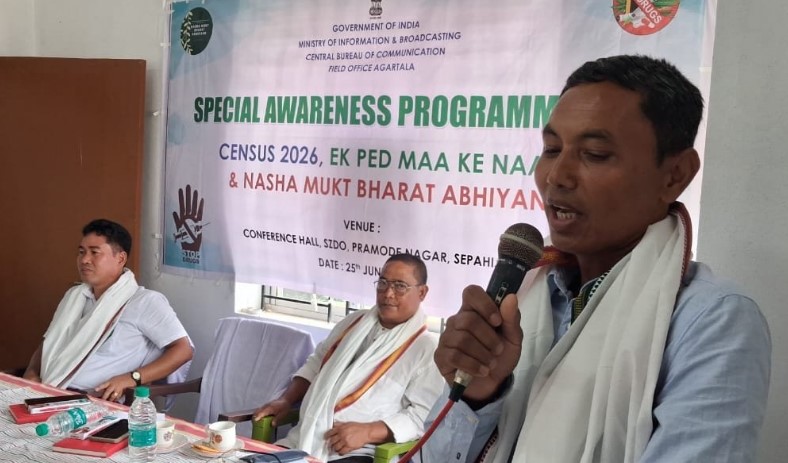
Census 2026, drug abuse prevention and environmental conservation featured in an awareness drive conducted at Pramode Nagar under the Sepahijala district of Tripura by the Central Bureau of Communication (CBC), Agartala and in the special awareness programme, officials highlighted public participation, online census access and community action during the event.
Quick Glance: Key Information
- CBC Agartala conducted the awareness programme at Sub-Zonal Development Office Conference Hall, Pramode Nagar.
- Census 2026 awareness was a major focus, with the first phase in Tripura expected from July 2026.
- Officials promoted the ‘Nasha Mukt Bharat’ Abhiyaan and urged youth to avoid drug abuse.
- A plantation drive under ‘Ek Ped Maa Ke Naam’ was organised at the office premises.
Agartala: A special awareness programme organised by the Field Office of the Central Bureau of Communication (CBC), Agartala, brought together administration officials, ADC representatives and local stakeholders to discuss three important national priorities.
The programme was held at the Conference Hall of the Sub-Zonal Development Office in Pramode Nagar. It focused on Census 2026, the ‘Nasha Mukt Bharat’ Abhiyaan and the environmental campaign ‘Ek Ped Maa Ke Naam’.
The initiative aimed to strengthen awareness among people at the grassroots level. It also encouraged citizens to participate actively in development-oriented programmes.
The event witnessed participation from ADC members of Sepahijala district. Local administrative representatives discussed the importance of community involvement in implementing government initiatives.
Ranjit Debbarma, Chairman of the Sub-Zonal Development Committee, TTAADC, Pramode Nagar, attended as the Chief Guest. During his address, he stressed the importance of public cooperation in achieving wider national development objectives.
Manik Lal Debbarma, Sub-Zonal Development Officer, participated as the Special Guest. He shared his views during the inaugural session and highlighted the importance of awareness programmes at the community level.
Census 2026 Awareness Takes Centre Stage in Tripura
The technical session of the programme focused strongly on civic responsibilities and government initiatives.
Senior Labour Inspector Aichuk Debbarma from the Labour Department, Government of Tripura, explained important aspects of the upcoming Census 2026 exercise.
Speaking to the media including Enewstime, officials confirmed that awareness efforts are being expanded to ensure citizens understand the census process and related responsibilities.
Aichuk Debbarma informed participants that the first phase of Census 2026 in Tripura is scheduled to begin in July 2026.
He also explained that citizens will have access to online platforms for applying and obtaining relevant information connected with the census process.
The census exercise is expected to play an important role in future planning, policy formation and development strategies. Accurate population data helps governments design welfare schemes and allocate resources effectively.
The awareness programme highlighted that public cooperation will remain a key factor for successful implementation.
Drug Prevention and Environmental Action Linked Through Community Participation
The programme also addressed social challenges affecting communities, especially young people.
ICDS Supervisor Austin Reang from the Department of Social Welfare and Social Education delivered a session on social welfare initiatives and environmental campaigns.
He appealed to the younger generation to stay away from weed consumption and harmful substances. He emphasised the importance of collective efforts to prevent drug-related problems.
Austin Reang also highlighted the need to stop illegal cannabis supply networks operating from neighbouring countries. He urged citizens to contribute towards building a healthier society.
Furthermore, he encouraged participants to join the ‘Ek Ped Maa Ke Naam’ plantation campaign.
The environmental initiative promotes tree plantation and encourages people to connect conservation efforts with community responsibility.
As part of the programme, a plantation drive was conducted within the office premises. Officials and participants planted saplings, reinforcing the message of environmental protection.
Why Awareness Campaigns Matter for Tripura and Northeast India
The Northeast region, including Tripura, faces unique challenges because of its geographical conditions, ecological sensitivity and social diversity.
Experts believe that awareness-based governance models can strengthen disaster preparedness, environmental protection and community resilience.
Tripura and other Northeastern states remain vulnerable to earthquake risks due to their location in the active seismic zone. The region has experienced several earthquakes historically, including damaging events in neighbouring areas.
A disaster-ready society requires accurate population information, stronger public communication and environmental awareness.
Census data can support better planning for infrastructure, emergency services and welfare delivery. At the same time, environmental campaigns can contribute to protecting natural resources.
According to disaster management experts, earthquake threats in the Northeast cannot be eliminated, but preparedness can reduce risks significantly. Public awareness, safer construction practices and community-level training remain important components of resilience.
The integration of Census awareness, anti-drug messaging and plantation activities reflects a broader approach where social development and environmental responsibility move together.
News Analysis: Enewstime Desk Perspective
The Sepahijala awareness programme reflects a growing administrative focus on connecting national initiatives with grassroots communities. In regions like Tripura, where local participation plays a crucial role, awareness campaigns can influence how effectively government programmes reach citizens.
The combination of Census 2026 preparation, anti-drug awareness and environmental action indicates a multi-dimensional governance approach. Beyond information sharing, such programmes attempt to build public ownership of development activities.
The earthquake vulnerability of Tripura and the Northeast adds another layer of importance. Reliable demographic information and community awareness can support stronger disaster management planning.
A well-informed population becomes an important partner in addressing future challenges, from climate concerns to public safety issues.
