

Professor Jayanta Choudhury of Nagaland University participated in a high-level IASSI Roundtable that brought together policymakers, academics and institutional leaders to discuss reforms for strengthening India’s social science ecosystem. The meeting also outlined preparations for the 25th IASSI Annual Conference at Nalanda University.
Kohima: Prof. Jayanta Choudhury, Head, Department of Rural Development and Planning, Nagaland University and Executive member of The Indian Association of Social Science Institutions (IASSI) joined a high-level Roundtable Dialogue on “Strengthening India’s Social Science Ecosystem: The Role of IASSI”, which bring together eminent policymakers, leading academics, Vice Chancellors, heads of national institutions and members of the IASSI Executive Committee to deliberate on the future of social science research in India. The dialogue was followed by the Executive Committee meeting to discuss institutional reforms and preparations for the forthcoming 25th IASSI Annual Conference at Nalanda University.
The Roundtable was chaired by Professor Sachin Chaturvedi, Vice Chancellor, Nalanda University and Chairman, IASSI. In the beginning Professor Alakh N. Sharma, Director, Institute for Human Development (IHD), welcomed the participants and emphasized the need for stronger collaboration among universities, research institutions, governments and civil society to make social science research more rigorous and socially relevant.
The discussions centred on strengthening interdisciplinary research, enhancing institutional collaboration, improving research quality, expanding research capacity, building stronger links between research and public policy, and increasing the public visibility of social science scholarship. These themes reflected IASSI’s broader vision of positioning itself as a national platform for research excellence and institutional leadership in the social sciences.
The Roundtable featured contributions from Professor S. Mahendra Dev, Chairman, Economic Advisory Council to the Prime Minister; Dr. R. Balasubramaniam, Member, NITI Aayog; Professor K. V. Raju, Member, NITI Aayog; Dr. Shivkumar Kalyanaraman, CEO, Anusandhan National Research Foundation (ANRF); Professor Shyama Rath, Secretary, University Grants Commission (UGC); Dr. Pankaj Mittal, Secretary-General, Association of Indian Universities (AIU); Professor S. R. Hashim, Former Chairman, UPSC and Former Member-Secretary, Planning Commission; Professor Sachin Kumar Sharma, Director General, RIS; Professor Umakant Dash, Vice Chancellor, Gokhale Institute of Politics and Economics; and Vice Chancellors of Panjab University, Jawahar Lal Nehru University, Rashtrasant Tukuadoji Maharaj Nagpur University, Nagpur, Babasaheb Bhimrao Ambedkar Bihar University, Muzaffarpur University; and several other eminent scholars and institutional leaders.
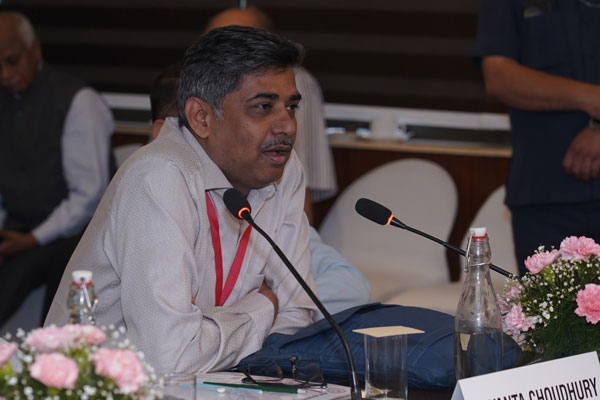
Participants underscored the importance of developing India-centric research frameworks rooted in indigenous knowledge systems while integrating advances in science, technology and artificial intelligence. They emphasized strengthening district-level data systems, promoting interdisciplinary and transdisciplinary research, expanding collaborations across institutions, creating stronger mentoring mechanisms for young scholars, and ensuring that research directly informs public policy and developmental planning. Special attention was also given to research on tribal communities, agriculture and allied sectors, MSMEs, climate change, digital transformation and employment gender equity, research ethics, and sustainable development.
A recurring theme throughout the discussions was the need to bridge the gap between academic research and societal impact. Participants advocated for greater community engagement, improved knowledge dissemination, stronger policy communication, enhanced field-based research, and wider participation of young researchers through internships, training programmes and institutional mentoring.
During the Executive Committee meeting, members deliberated on a roadmap for strengthening IASSI as India’s premier association of social science institutions. Key decisions included expanding thematic research tracks, introducing dedicated sessions on research ethics and integrity, promoting collaborations with national and international institutions, strengthening research outreach, establishing structured training programmes for early-career researchers, instituting recognition awards, organizing regional conferences, expanding institutional membership, creating sustainable funding mechanisms, modernizing governance systems and enhancing IASSI’s digital presence.
In his closing remarks, Professor Sachin Chaturvedi reaffirmed IASSI’s commitment to expanding its institutional network, strengthening methodological training for young scholars, promoting responsible use of artificial intelligence in research, and positioning IASSI as a leading national platform for advancing evidence-based public policy and social science scholarship.
The meeting also reviewed preparations for the 25th IASSI Annual Conference, which will be hosted by Nalanda University, and outlined strategies to broaden participation from universities, research institutions and policy organizations across the country.
The Executive Committee for the 2026–28 term comprises eminent scholars and institutional leaders from universities, research institutes and national organizations across India, reflecting IASSI’s growing commitment to strengthening collaboration, promoting research excellence and advancing India’s social science ecosystem.
