

Hidden deep inside the Baramura Hills of West Tripura, a tiny tribal settlement without road connectivity is preserving generations of indigenous ecological knowledge. A recent census visit to Gatichhara village has brought renewed attention not only to the community’s isolation but also to the risk of losing centuries-old traditional wisdom that remains undocumented.
At a Glance
- A census visit revealed the extreme isolation of Gatichhara village in West Tripura.
- Three tribal families continue to live without road connectivity.
- Residents possess rich traditional knowledge of forests, water sources and biodiversity.
- Migration and changing lifestyles threaten the survival of this indigenous knowledge.
- Local representatives have urged the government to improve connectivity while preserving the community’s cultural heritage.
A Remote Village Preserving Centuries of Wisdom
Agartala/Dharmanagar, August 06: Far from the expanding highways and growing urban centres of Tripura, a small tribal settlement tucked away in the Baramura Hills continues to live almost unchanged by modern development.
Gatichhara village, located in Hezamara Block of West Tripura district, consists of only three households. Yet the settlement represents far more than a remote habitation. It is home to generations of indigenous knowledge about forests, wildlife, water management and mountain ecology that has largely remained outside formal documentation.
The village recently came into focus after National Award-winning science teacher Anjan Banik reached the settlement during census-related fieldwork. His journey through dense forests and steep hill slopes highlighted not only the area’s physical isolation but also the remarkable traditional knowledge preserved by its residents.
No Roads, Only Forest Trails
Reaching Gatichhara is an expedition rather than a routine journey. With no internet and help from Google Map, trekking to reach the village reveals a harsh reality – living far from the developed yet chaotic urban life under the cover of lush greenery.
The last motorable point is at Amisha Dangar Battala. From there, visitors must trek for nearly one-and-a-half hours through thick forests, crossing uneven hill terrain where no proper pathway exists. During the monsoon, even the faint foot trails disappear beneath rapidly growing vegetation.
Banik recalled that the route required cutting through branches and clearing foliage to identify the narrow mountain tracks.
At several locations, the forest offered multiple directions with no visible indication of the correct route. The team relied on distant sounds from inhabited areas to confirm they were moving towards the village.
The experience illustrated how disconnected some mountain communities remain despite rapid infrastructure expansion elsewhere in the state.
Life Shaped by Nature
Only eight tribal residents currently live in the first three households of Gatichhara.
The families sustain themselves through organic vegetable cultivation and traditional jhum farming. Their livelihood depends almost entirely on the surrounding forest ecosystem.
Unlike modern farming communities, these families continue to rely on intimate knowledge of rainfall patterns, hill slopes, seasonal vegetation and natural water sources.
Their understanding of the local landscape has been developed over generations and passed down through experience rather than written records.
This traditional ecological knowledge enables them to survive in an environment that remains inaccessible to conventional public services.
Water Determines Settlement Patterns
One of the most striking observations during the visit was the relationship between water availability and human settlement.
According to Banik, tribal communities in the hills originally lived together in clustered settlements. Over time, however, increasing demand for water forced families to establish separate homes near different hill streams.
Each household created its own natural well beside a stream to secure a reliable source of water. As a result, families gradually spread across different hilltops while remaining part of the same village community.
This pattern reflects a sophisticated understanding of mountain hydrology developed long before modern water management systems reached these remote areas.
Knowledge That Risks Disappearing
Beyond survival skills, the villagers possess extensive knowledge of forest biodiversity.
They understand local tree species, medicinal plants, seasonal changes, wildlife behaviour and natural resources that are rarely documented in scientific literature.
Banik believes this traditional knowledge deserves systematic documentation before it disappears with changing generations.
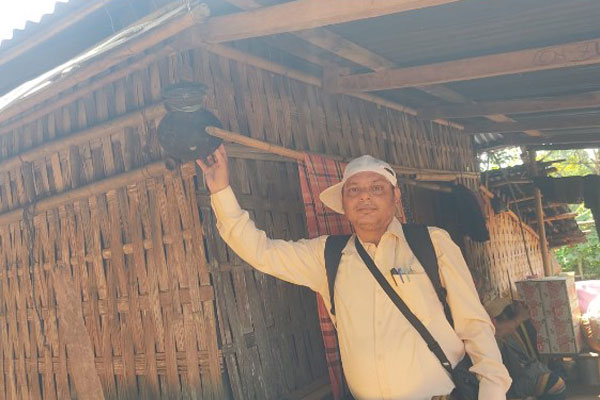
He observed that the community’s understanding of the forest represents a valuable repository of indigenous environmental knowledge. However, very little effort has been made to formally record or preserve it.
As younger generations increasingly migrate towards towns in search of education and employment, such knowledge may gradually vanish unless dedicated conservation efforts begin.
Development Challenges Continue
Despite their resilience, the residents continue to face serious hardships.
The absence of road connectivity affects every aspect of daily life. Healthcare remains the biggest concern.
Snake bites and attacks by wild bears are common risks for people living in the area. Accessing medical treatment requires walking long distances through forests before reaching transport facilities.
One elderly resident has reportedly continued living with complications following repeated snake bites because advanced medical care remains difficult to access.
Electricity is another challenge. Although two of the three houses now benefit from solar-powered lighting, the settlement remains disconnected from the conventional power network.
The solar installations have nevertheless transformed daily life by providing basic lighting after sunset and improving safety for families living amid dense forests.
Calls for Connectivity Without Losing Heritage
Following the visit, local Ward Member Krishna Kishore Debbarma appealed to the government to improve road connectivity from Dumrakari through Amisha Dangar Battala to Gatichhara village.
He also proposed extending the route towards Chankhala Bazaar in Khowai district to create an inter-district road network that could improve access to education, healthcare and markets.
However, observers note that development in such ecologically sensitive areas must strike a balance between improving public services and preserving indigenous culture and environmental knowledge.
Experts increasingly recognise that traditional ecological practices can complement modern conservation strategies, particularly in biodiversity-rich hill regions.
A Reminder from the Hills
The census visit to Gatichhara has done more than record population data. It has revealed a community that continues to preserve a living relationship with nature while remaining largely invisible to mainstream society.
In an era when climate resilience, biodiversity conservation and sustainable living are global priorities, the experiences of these mountain communities carry lessons that extend far beyond Tripura.
As development gradually reaches every corner of the state, documenting and respecting indigenous knowledge may prove just as important as building roads. For villages like Gatichhara, preserving cultural wisdom alongside improving connectivity could become the foundation for truly inclusive development.