

In view of growing resentment among power consumers over higher electricity bills and concerns surrounding smart meters, Power Minister Ratan Lal Nath said the Tripura Government is examining measures to provide relief and is expected to announce a decision soon after Chief Minister Dr Manik Saha returns from New Delhi. Amid criticism from Opposition parties over the issue, Nath sought to shift the political narrative by pointing out that smart-meter programme in Tripura was launched during the CPIM-led Left Front government.
Key Takeaways
- Power Minister Ratan Lal Nath said the government has taken note of consumer dissatisfaction over electricity bills.
- The Smart Grid work order worth ₹80.07 crore was issued in September 2015 during the CPIM-led Left Front government. He asked as to why ex-CM Manik Sarkar has not called the press and revealed this.
- An audit flagged ₹42.76 crore as unfruitful expenditure in the Smart Grid project.
- Nath said the government is considering measures to provide relief to consumers within the next few days.
- He also clarified that smart meters and prepaid meters are different systems.
Agartala, August 11: The Tripura government has acknowledged growing resentment among electricity consumers over higher bills and concerns surrounding smart meters, with Power Minister Ratan Lal Nath saying the administration cannot remain a silent spectator.
At the same time, Nath turned the smart-meter debate into a political issue to counter allegations by opposition parties. He argued that the initiative did not originate with the present government but was launched during the CPIM-led Left Front government.
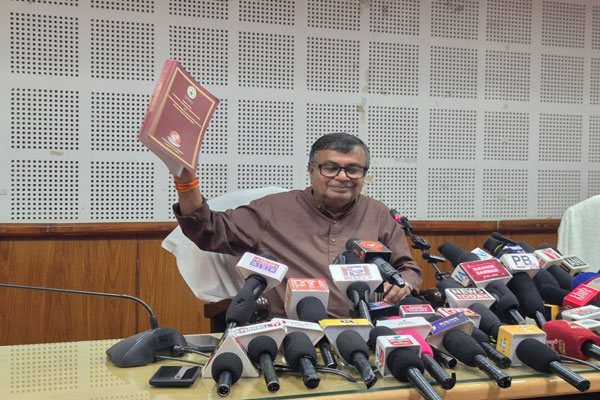
Addressing a press conference on Tuesday, Nath said Chief Minister Dr Manik Saha, senior ministers and top officials had already discussed the electricity bill issue. The government is now examining possible measures to provide relief to consumers.
“We are doing something in the interest of consumers,” Nath said, indicating that a decision could be taken within the next few days.
Government Takes Note of Consumer Resentment
The minister said complaints over electricity bills, particularly bills effective from May, have created dissatisfaction among consumers.
He stressed that electricity tariffs are determined by the regulatory commission and that TSECL does not have unrestricted authority to increase or reduce rates.
According to Nath, the commission considers electricity purchase costs, salaries, maintenance expenses and other components before determining the tariff structure.
It also fixes fixed charges, energy charges and the Fuel and Power Purchase Cost Adjustment (FPPCA) component.
However, Nath said the state government could not simply distance itself from the issue by arguing that tariff fixation is the responsibility of the regulatory commission.
“The state government cannot remain a silent spectator,” was the central message of his statement.
The issue has become particularly significant as Tripura now has around 10.68 lakh electricity consumers, according to Nath. He said the consumer base has increased substantially from the level recorded before 2018.
Smart Meter Debate Takes Political Turn
While addressing consumer concerns, Nath sharply challenged the political narrative surrounding smart meters.
He said political opponents were attempting to “fish in troubled waters” by blaming the present government for the smart-meter system.
Nath then referred to a Times of India report published on July 9, 2017, which recorded the decision of the then Left Front government to install smart meters across Tripura.
The report, he said, quoted then Power Minister Manik Dey as announcing the replacement of conventional meters with smart meters.
Nath’s argument was direct: the smart-meter programme had already been initiated when the CPIM-led Left Front government was in power.
He questioned why the political debate was now being framed as if the present government had introduced the system.
₹80.07-Crore Smart Grid Work Order Issued in 2015
The minister backed his political argument with documents relating to the Smart Grid Pilot Project.
According to the documents, TSECL issued a work order on September 22, 2015, for implementation of Smart Grid elements in Electrical Division-I, Agartala.
The contract was awarded to a consortium led by Wipro Limited, with JnJ Powercom Systems Limited as another consortium partner.
The total contract value was ₹80,07,68,757, or about ₹80.07 crore.
| Component | Amount |
|---|---|
| Plant and equipment | ₹54.95 crore |
| Installation and training | ₹8.45 crore |
| Maintenance | ₹16.68 crore |
| Total contract | ₹80.07 crore |
The project itself had initially been approved at ₹24.08 crore in 2012. Its cost was later revised to ₹63.43 crore in August 2015.
Audit Raises Separate Questions Over Implementation
Nath’s political argument does not, however, remove the audit concerns surrounding the project’s implementation.
An audit observation dated October 23, 2024, flagged ₹42.76 crore as unfruitful expenditure in the Smart Grid project.
The audit also stated that deficiencies and financial irregularities resulted in an extension that amounted to undue favour to the contractor.
Nath was careful to distinguish the audit’s observation from any allegation of corruption. He said he had not accused anyone of theft or alleged that anyone had taken a particular percentage of the contract value.
His point, he said, was that the audit had formally raised questions about the project’s financial outcome and the extension granted to the contractor.
Project Faced Major Delays and Technical Problems
The audit findings also provide details of the implementation problems.
The project was scheduled for completion within two years. However, the work continued well beyond the deadline.
Of 45,290 smart meters planned for installation in Electrical Division-I, the consortium installed 43,081 by July 2019.
The audit described this as an inordinate delay of 27 months from the scheduled completion period.
More importantly, only 34,300 of the installed meters were initially found to be communicating with the control centre.
Within two to three months, those meters also stopped communicating because of technical glitches.
The project therefore failed to deliver the intended Smart Grid functionality on the scale originally envisaged.
The audit also pointed to around ₹1.10 crore in expenditure on manual meter reading and billing, as the intended system remained incomplete.
Nath Separates Smart Meters From Prepaid Meters
Amid the controversy, Nath also sought to clear what he described as another area of public confusion.
He said smart meters and prepaid meters are not the same.
Tripura has around 1.64 lakh standalone prepaid meters, according to the minister.
A prepaid meter works on the basis of available or recharged credit. Smart meters, on the other hand, form part of a broader digital metering and communication system.
Nath also said a server failure had previously affected prepaid consumers. He claimed consumers were not disconnected because the technical failure was attributable to the system rather than the consumers.
TSECL subsequently decided to recover accumulated charges gradually over six months rather than impose the entire amount at once, he said.
Abnormal Bills Also Under Government Watch
Nath acknowledged complaints about unusually high electricity bills.
He said some consumers had received bills far above their normal consumption. Such cases could result from errors in meter reading, he said.
TSECL officials have been instructed not to collect such disputed bills until they are examined.
Nath further warned that if abnormal bills continue to be issued because of negligence by meter readers, the concerned DGM would be held responsible.
Enewstime Editor-in-Chief’s Perspective
The smart-meter controversy has now developed on two parallel tracks.
For the government, the immediate challenge is to respond to consumer resentment over electricity bills, particularly complaints of unusually high bills, while examining measures to provide relief.
At the political level, Nath sought to counter criticism from Opposition parties by highlighting the origin of the smart-meter programme. Backed by official documents, he pointed to the September 2015 work order worth ₹80.07 crore and a Times of India report from July 2017 quoting then Power Minister Manik Dey on the rollout of smart meters.
Nath’s argument was that the present BJP-led government did not introduce the smart-meter programme. It inherited a project that had been initiated during the previous CPIM-led Left Front government.
At the same time, the CAG audit findings have created a separate accountability issue over project’s implementation in the Left Front era, including the ₹42.76-crore unfruitful expenditure, prolonged delays and technical failures.
