

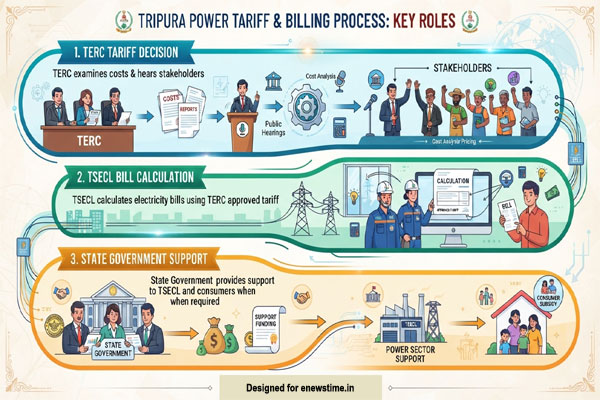
The Tripura Electricity Regulatory Commission (TERC) decides power tariffs in the state, while TSECL calculates consumer bills using approved rates. The State Government does not directly fix tariffs but can support TSECL and/or provide relief to consumers when necessary.
Quick Glance
- TERC decides the tariff after examining TSECL’s costs and hearing stakeholders.
- TSECL calculates electricity bills using the tariff approved by TERC.
- State Government provides support to TSECL and consumers when required.
- FPPCA, fixed charges and energy charges form key components of electricity bills.
- Tripura has around 10.68 lakh electricity consumers, making tariff decisions significant for households and businesses.
Agartala, August 12: Amidst reported resentment among electricity consumers, Power Minister of Tripura, Ratan Lal Nath detailed the process of power tariff determination and electricity bill generation.
The Tripura Electricity Regulatory Commission holds the key role in deciding electricity tariffs. TERC functions as an independent regulatory body. It determines how much consumers can pay for electricity under different categories.
| Related News: Tripura Power Bill Row: Govt Plans Relief, Nath Says Smart Meters Rolled Out Under Left Front |
The process starts with TSECL placing its financial requirements before the commission. The corporation provides details of its expenses and revenue requirements. These can include power purchase costs, salaries, maintenance and other operational expenses.
TSECL can also report losses incurred during the previous financial year. However, TERC does not automatically approve the corporation’s claims. The commission examines the figures before determining the allowable costs and tariff structure. It also considers the interests of consumers and other stakeholders.
This makes TERC the central authority in the tariff-setting process.
Public hearing before tariff revision
A tariff revision does not happen simply because TSECL wants higher revenue. The regulatory process includes public participation. After receiving TSECL’s proposal, TERC issues a public notice. It invites objections and suggestions from consumers and other stakeholders.
The commission also fixes a date for a public hearing. Consumers and other stakeholders can present their views during the process. TERC then examines the submissions along with TSECL’s financial requirements.
It subsequently determines the tariff.
Therefore, TSECL cannot independently increase electricity tariffs. Any revision has to go through the regulatory mechanism.
What does TERC decide?
The tariff approved by TERC contains several components. The energy charge is the component most consumers associate with electricity consumption. It generally depends on the units of power consumed.
There is also a fixed charge. Another important component is the Fuel and Power Purchase Cost Adjustment (FPPCA).
FPPCA allows adjustments based on changes in fuel and power purchase costs. Changes in the cost of purchased electricity or fuel can therefore affect the applicable charge.
TERC determines the permissible adjustment under the regulatory framework. The commission also determines tariff slabs for different categories. Domestic consumers have slab-based rates. The tariff structure can differ for single-phase and three-phase connections.
Commercial and industrial consumers have separate tariff categories. Thus, the tariff structure reflects both consumption and consumer category.
TSECL calculates the electricity bill
If TERC decides the tariff, the next question is: Who calculates the bill?
The answer is TSECL.
The Tripura State Electricity Corporation Limited supplies and distributes electricity and calculates consumer bills according to the rates approved by TERC. The bill can include the applicable energy charge, fixed charge, FPPCA and other charges permitted under the prevailing tariff order.
This distinction is important. Consumers receive their electricity bills from TSECL. But TSECL does not have unlimited freedom to determine the rates used in those bills. The corporation applies the tariff approved by the regulator.
If TSECL believes that higher costs require a tariff revision, it must approach TERC with the necessary details. The corporation cannot simply pass every increase in its expenses directly to consumers.
State Government has a support role
The State Government has a different responsibility in the system. It does not directly determine the electricity tariff. That function rests with TERC. However, the government cannot remain disconnected from the power sector.
TSECL may seek government assistance when it faces financial or operational challenges. The State Government can extend policy and financial support to the corporation when necessary. It can also consider measures to provide relief to consumers when circumstances demand it. This creates a clear distinction between regulation and government support.
TERC decides the tariff. TSECL operates the distribution system and calculates bills. The government supports the power sector and consumers when required.
TSECL operates through its own structure
TSECL has its own board and management system. Power Minister Ratan Lal Nath said the corporation has around 2,000 employees. The Power Department, by comparison, has around 13–14 employees.
The minister also explained that TSECL’s day-to-day administrative matters do not directly come under his control in the manner of a conventional government department.
The corporation functions through its board and management. The board is headed by the Secretary, Power. Administrative decisions, including appointments and transfers, follow the corporation’s institutional process.
Top-level matters may come up for consultation with senior government officials when required. This structure reinforces the distinction between the State Government and TSECL’s day-to-day administration.
Why the distinction matters to consumers
The roles of the three institutions matter when consumers face higher electricity bills. A higher bill does not automatically mean that TSECL has increased the tariff. The final bill can change because of higher consumption, tariff slabs, fixed charges or permitted adjustments such as FPPCA.
TSECL calculates the bill by applying the rates in force. If the tariff itself needs to change, the proposal must go through TERC. The commission then examines the proposal and hears stakeholders before taking a decision.
10.68 lakh consumers make tariff issue significant
Tripura currently has around 10.68 lakh electricity consumers. The figure can change as new connections are added. For such a large consumer base, the balance between affordable electricity and the financial health of TSECL remains important.
The corporation must meet its power purchase costs, salaries, maintenance expenses and other operational requirements. Consumers, meanwhile, expect reliable power at affordable rates. The regulatory system attempts to balance both sides.
Three institutions, three distinct roles
The power tariff system becomes easier to understand when the roles are separated. TERC decides the tariff. It examines TSECL’s financial requirements, considers stakeholder objections and determines the applicable rates.
TSECL calculates the electricity bill. It applies the approved tariff to consumer consumption and issues the bill. The State Government provides support. It handles broader power-sector policy and can extend assistance to TSECL and consumers whenever necessary.
