

A new 480-seat Eklavya Residential Model school (EMRS) at Killa in Gomati district of Tripura is set to widen access to quality education for children from tribal communities, offering students an integrated learning and residential environment closer to their homes.
Quick Glance
- A 480-seat EMRS has opened at Killa under Killa RD Block in Gomati district.
- The school aims to combine quality education with residential facilities for tribal students.
- Tribal Welfare Minister Bikash Debbarma said financial hardship should not stop talented students from pursuing education.
- Speaker Rampada Jamatia inaugurated the institution on Thursday.
- The programme concluded with a tree plantation drive.
Killa (Tripura) August 13: The 480-seat Eklavya Model Residential School (EMRS) at Killa under Killa RD Block in Gomati district has opened with a clear focus on improving educational access for tribal children.
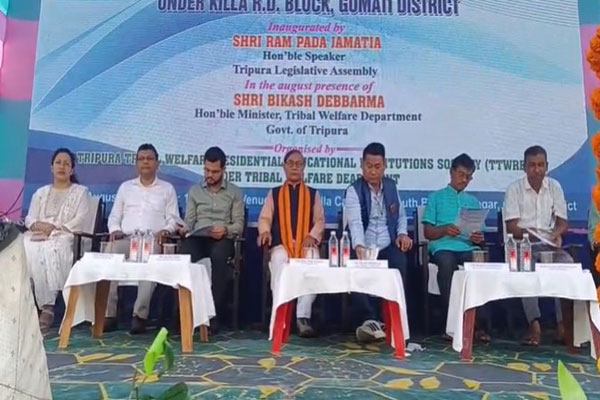
Tripura Legislative Assembly Speaker Rampada Jamatia formally inaugurated the institution on Thursday. Tribal Welfare Minister Bikash Debbarma attended the programme as the chief guest.
The new school is designed to provide more than classroom education. It will offer students a residential environment where they can study, stay and access educational facilities in one place.
This model is particularly important for students from remote tribal-dominated areas. Distance, limited educational infrastructure and financial constraints can often affect their access to quality schooling.
The Killa EMRS seeks to address these challenges through an integrated residential education system.
Quality Education and Residential Support
The primary objective of an Eklavya Model Residential School is to provide quality education along with residential facilities to students from tribal-dominated areas.
The Killa institution therefore represents more than the addition of 480 seats to Tripura’s education infrastructure. It creates an opportunity for tribal students to continue their studies in a structured residential setting.
For families in remote areas, residential schooling can reduce the difficulties associated with daily travel. It can also give students greater access to teachers, academic resources and a regular study environment.
The approach can be especially valuable for children from economically weaker families.
Financial Barriers Remain a Key Concern
Addressing the inaugural programme, Tribal Welfare Minister Bikash Debbarma said the government wants to ensure that financial difficulties do not interrupt the education of talented tribal students.
He said the establishment of EMRS institutions in tribal-dominated areas reflects this objective.
According to the minister, the government has taken several steps to strengthen educational infrastructure in tribal areas under the leadership of Chief Minister Professor Dr Manik Saha.
He also highlighted education initiatives taken by the Central Government for tribal students under Prime Minister Narendra Modi.
“Without education, the overall development of any community or society is not possible,” Debbarma said.
He added that educated tribal youth would have an important role in the future development of society and Tripura.
Residential Learning for Remote-Area Students
Speaker Rampada Jamatia also underlined the importance of residential education during the inauguration.
He stressed the need for such institutions for students living in remote areas.
The EMRS model can give students an opportunity to pursue their education without facing the same access barriers that may exist in distant or underserved locations.
The Killa school can therefore become an important educational support system for tribal families in and around the area.
Its 480-seat capacity also provides scope to serve a substantial number of students over the coming years.
Education and Environment Highlighted : Enewstime Desk Perspective
District administration officials, elected representatives, Tribal Welfare Department officials, teachers, students, parents and local residents attended the inauguration.
The programme began with the lighting of ceremonial lamps after the unveiling of the inauguration plaque.
The event concluded with a tree plantation drive on the school premises. Ten invited guests participated in the initiative.
The combination of the new residential school and the plantation programme placed education and environmental responsibility at the centre of the inauguration.
For tribal students in Gomati district, the Killa EMRS now offers a new platform to pursue quality education in a residential setting.
