

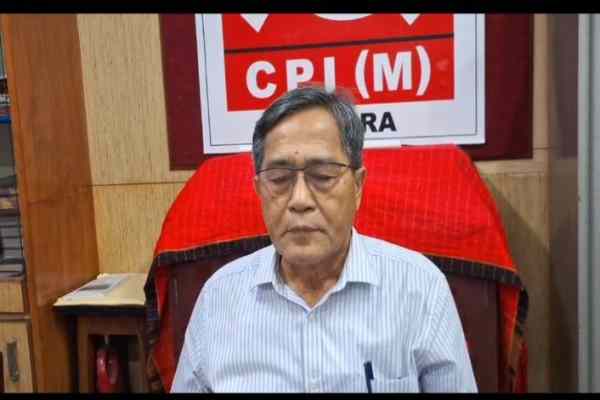
CPIM Tripura State Secretary Jitendra Choudhury has urged the state government to withdraw its decision to relax the Permanent Resident of Tripura Certificate requirement in selected government recruitment. He warned that the move could increase competition for local job seekers and create scope for recruitment irregularities.
3 Key Takeaways
- CPIM State Secretary Jitendra Choudhury opposed the relaxation of PRTC requirements in government recruitment.
- He said the move could affect thousands of unemployed youths waiting for government jobs.
- Choudhury backed limited recruitment of outside experts in specialised fields but opposed a blanket relaxation.
Agartala, August 14: The Tripura PRTC issue has triggered fresh political opposition after CPIM State Secretary Jitendra Choudhury criticised the state Cabinet decision to relax the Permanent Resident of Tripura Certificate requirement for certain government job applicants. Choudhury said the decision could affect local job seekers and create scope for irregularities in government recruitment.
The CPIM leader said the government has repeatedly shown a lack of maturity while taking important and sensitive decisions. He made the remarks while discussing the latest recruitment policy and broader employment concerns in Tripura.
CPIM Questions Change in PRTC Requirement
Choudhury said Tripura had developed a system to protect opportunities for local candidates in several categories of government employment.
He referred to Group B, Group C and Group D jobs in particular. According to him, recruitment rules were more open during the 1950s and 1960s. At that time, Tripura had a limited number of educated people.
The situation changed as education expanded across the state.
Choudhury said the Left Front government later introduced measures to ensure that young people from Tripura received greater access to these government jobs. He argued that similar arrangements existed in several other states.
The CPIM leader claimed that the BJP government changed the system after coming to power in 2018.
Concern Over Outsiders in Government Recruitment
Choudhury alleged that the government removed the mandatory PRTC requirement for certain recruitment processes. He claimed that the change created an opportunity for candidates from outside Tripura to enter government service.
He referred to states including Bihar, Uttar Pradesh, Gujarat, West Bengal and Assam.
According to Choudhury, the relaxation affected even lower-category government jobs. He said the issue had triggered strong public reaction in the past.
The CPIM leader now sees the latest Cabinet decision as another potential opening for candidates from outside the state.
He described it as a “backdoor” route that could benefit people seeking opportunities without adequate safeguards for local candidates.
Unemployed Youth at Centre of Debate
Choudhury said the decision could have a serious impact on Tripura’s unemployed youth.
Thousands of educated and semi-educated youths are waiting for government jobs, he said. Many have appeared in recruitment examinations and interviews over the years.
He also pointed to vacant government posts that remain unfilled.
According to Choudhury, relaxing eligibility rules could increase competition for these positions. He warned that local candidates could face greater difficulties in securing government employment.
He described the proposed change as “anti-youth” and “anti-unemployed”.
The CPIM leader demanded that the government withdraw the decision.
CPIM Supports Selective Expert Recruitment
Choudhury, however, said Tripura could bring professionals from outside the state in areas where suitable expertise is unavailable locally.
He cited specialised positions as examples.
These could include university professors, super-speciality doctors and other highly specialised professionals. He also referred to the judiciary as an area where such arrangements already exist.
However, he opposed what he described as a blanket relaxation of the recruitment system.
Choudhury argued that the government should identify specific areas where Tripura lacks trained professionals. It can then recruit outside experts for those positions.
He said such a targeted approach would be different from opening government recruitment broadly to candidates from outside the state.
Arunachal Policy Cited as Contrast
Choudhury also compared Tripura’s decision with a recruitment policy in Arunachal Pradesh.
He pointed out that Arunachal Pradesh also has a BJP-led government. According to him, the state has introduced provisions linked to knowledge of local indigenous languages for government employment.
He used the comparison to question what he described as the BJP’s “double standard” on protecting local employment opportunities.
Choudhury argued that states such as Tripura need safeguards because government jobs remain a major source of employment for educated youths.
CPIM Demands Withdrawal of Cabinet Decision
The CPIM leader said the government must reconsider its decision on the PRTC requirement.
He warned that any broad relaxation could create fresh disputes over government recruitment. It could also increase concerns about transparency and fairness.
For Tripura’s unemployed youth, the issue goes beyond eligibility rules, he said. It concerns access to a limited number of government jobs in a state where many young people continue to wait for recruitment opportunities.
Choudhury therefore urged the government to withdraw the decision and retain stronger safeguards for local candidates.
The CPIM leader maintained that recruitment rules should balance the need for specialised expertise with the interests of Tripura’s permanent residents. He said the government must ensure that changes to the system do not undermine opportunities for local job seekers.
