

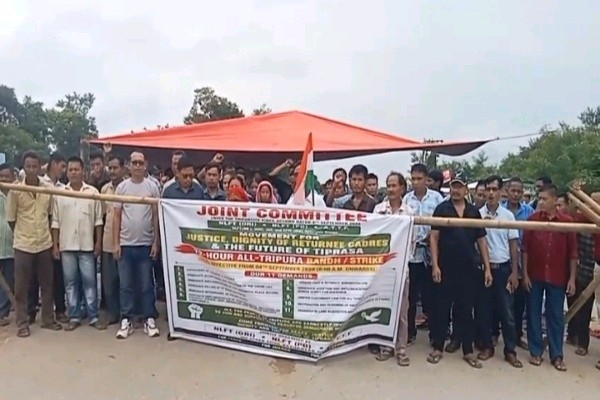
Patients, children, elderly people and daily commuters were among those caught in second day of 72-hour road blockade in Tripura on Saturday.
As vehicles remained stranded at key points, protesters intensified pressure on the government to implement rehabilitation commitments for surrendered militants.
Key Takeaways:
- The 72-hour Tripura blockade entered its second day, leaving vehicles and commuters stranded at several locations.
- Protest representative Jibanjoy Reang warned of indefinite agitation and possible escalation if rehabilitation demands remain unresolved.
- TMP MLA Ranjit Debbarma urged the government to bring all stakeholders together and find a permanent solution to recurring blockades.
The 72-hour blockade by surrendered militant groups in the State entered its second day on Saturday, disrupting road movement across the state and leaving large numbers of people stranded.
Long queues of vehicles formed at several blockade points. Passengers waited for hours. Workers and students faced difficulties reaching their destinations. The disruption also affected patients travelling for medical treatment.
Reports from affected areas said some critical patients remained stranded despite requiring medical support. Children and elderly people were also caught in the prolonged disruption.
The Barmura blockade point emerged as one of the major locations where traffic remained severely affected. With road movement restricted, passengers had few immediate options for continuing their journeys.
The protesters have called the blockade to press for implementation of rehabilitation and resettlement commitments for surrendered militants. They allege that the Tripura government has failed to properly implement commitments made under an agreement with the Centre.
Protesters Demand Rehabilitation Commitments
The protesters say surrendered militants returned to civilian life after giving up armed activities and choosing peace.
They now want the government to fulfil rehabilitation commitments relating to education, housing and other support.
Jibanjoy Reang speaking to the media demanded immediate government intervention.
Reang said the protesters had surrendered and returned to civilian life after choosing peace and respecting the Constitution. However, he alleged that many still await concrete rehabilitation support.
He claimed that other states had implemented Centre-funded rehabilitation packages more effectively. Tripura, he alleged, had failed to provide similar support to several surrendered militants.
Reang demanded a written assurance from the state government.
He said the protesters would consider talks if the government provided such an assurance within the stipulated period.
Jibanjoy Reang Warns of Escalation
Reang issued a strong warning if the government fails to respond to the protesters’ demands.
He said the protesters were not ordinary members of the public but former militants with training in weapons and explosives. At the same time, he stressed that they wanted peace and respected the law.
Reang urged the chief minister to engage directly with the protesters and take steps to implement the agreement with the Government of India.
Reang further warned that the agitation could continue indefinitely after the 72-hour blockade if the government failed to respond.
Warning of Return to Former Life
Reang also raised a more serious concern.
He warned that some surrendered militants could consider returning to their previous life if their demands remained unresolved.
He said they had earlier abandoned violence and returned to normal civilian life.
According to Reang, the lack of concrete rehabilitation measures has pushed them back onto the streets.
TMP MLA Ranjit Debbarma Seeks Permanent Solution
The blockade issue had already come under scrutiny in the Tripura Assembly during its recently concluded session.
TMP MLA Ranjit Debbarma questioned the government’s handling of repeated blockades by surrendered militant groups.
Debbarma said recurring road blockades directly affect ordinary people. They disrupt transport and create difficulties for commuters, businesses and emergency travellers.
He pointed out that earlier blockades ended after intervention by the administration. Officials from the Tribal Welfare Department, police and civil administration held discussions with protesters and gave assurances.
However, similar protests later returned.
Debbarma questioned why the cycle had continued despite repeated meetings.
He urged the government to adopt a comprehensive mechanism instead of dealing separately with different groups every time a blockade begins.
MLA Calls for Stakeholder Dialogue
Debbarma also questioned whether all groups involved in the protests fall under the September 4, 2024 tripartite agreement.
He urged the government to bring all stakeholders together and clarify the scope of the agreement.
The MLA argued that repeated negotiations without a permanent settlement would not resolve the underlying grievances.
His appeal comes as the current blockade enters its second day and public frustration grows at affected locations.
The immediate challenge for the government is to balance the protesters’ rehabilitation demands with the public’s right to uninterrupted movement.
For the protesters, the demand remains clear: they want written assurances and implementation of rehabilitation commitments.
For the government, the continuing blockade highlights the need for a structured response rather than repeated temporary interventions.
With the 72-hour blockade still underway, attention now remains on whether the government will engage directly with the protesters and prevent the agitation from extending beyond the announced shutdown period.
