

A historic Naga peace site in Mokokchung became the centre of a renewed call to preserve the legacy of dialogue on Sunday as Nagaland observed September 6 as Peace Day. The event brought together church leaders, Naga political representatives and local stakeholders to remember the 1964 ceasefire and its continuing relevance to the region’s peace efforts.
Key Takeaways
- Nagaland marked the 63rd Indo-Naga Ceasefire Day at the historic Peace Talk Camp in Khensa, Mokokchung.
- Speakers recalled the 1964 ceasefire and reiterated differing positions on Naga sovereignty and self-determination.
- Organisers urged NBCC-affiliated churches to observe September 6 as Peace or Ceasefire Day from next year.
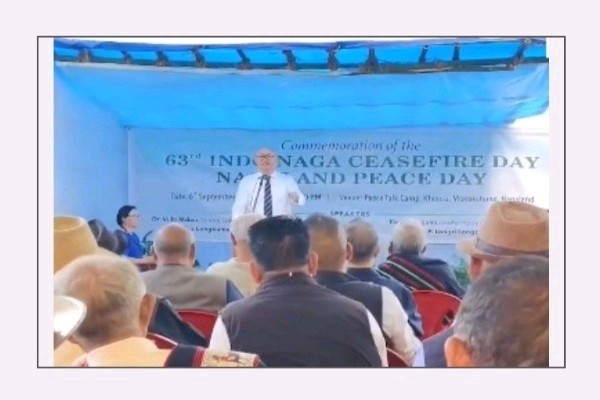
Nagaland on Sunday commemorated the 63rd Indo-Naga Ceasefire Day as Nagaland Peace Day at the historic Peace Talk Camp at Yimyu Hilltop in Khensa, Mokokchung district.
The location is closely associated with the Indo-Naga peace process. The 1964 ceasefire was facilitated by the Peace Mission of the Nagaland Baptist Church Council (NBCC).
The Peace Mission included B.P. Chaliha, Reverend Michael Scott and Jayaprakash Narayan. Their intervention helped create an avenue for dialogue between the Naga political movement and the Government of India.
Covenant Stone Dedicated at Khensa
The day’s programme began with the inauguration and dedication of the Covenant Stone, known as Azungashi Long.
Dr Tsuknunglenla, an associate professor at Clark Theological College, chaired the formal session. Reverend Dr Akok Amer offered the dedicatory prayer.
Organisers described the Peace Talk Camp as an Azungashi, or covenant. The site represents an important chapter in the history of the Naga peace initiative.
The commemoration also highlighted the history of the land on which the camp stands.
According to the organisers, four descendants of the Leubaza clan of Khensa — Mapukaba, Merenmayang, Temsunungba and Pangertoshi — gifted their ancestral land at Yimyu Tenem to the Naga nation.
The land was offered on September 6, 1964, at the request of the Federal Government of Nagaland. The objective was to support the vision associated with the ceasefire.
The agreement remained verbal for several decades. It was later documented in writing after meetings involving Pangertoshi Leubaza’s descendants, the Federal Government and the Khensa Village Council.
Copies of the document were handed to representatives of the concerned parties.
NNC Restates Naga Political Position
Takuyaba Longkumer, a Central Executive Committee member of the Naga National Council (NNC), addressed the gathering on “The Indo-Naga Position”.
Longkumer argued that Naga independence was not a new political demand. He said the Nagas had declared independence on August 14, 1947.
He also referred to the Naga Voluntary Plebiscite conducted on March 16, 1951. According to the NNC, 99.9 per cent of voters supported independence.
Longkumer described the 1964 ceasefire as a major milestone in the Naga political movement.
He said Naga civilians suffered heavily during the prolonged conflict and military operations that preceded the ceasefire.
Longkumer credited the NBCC-led Peace Mission with creating conditions for negotiations and a possible lasting settlement.
| More Northeast News here |
He further maintained that the Federal Government of Nagaland and the NNC continued to uphold the 1964 ceasefire while retaining their position on Naga sovereignty.
Longkumer also cited the United Nations Declaration on the Rights of Indigenous Peoples, adopted in 2007. He said the principle of self-determination remained central to the Naga political position.
FGN Recalls 1964 Ceasefire Terms
Kezha Angami, Kedahge of the Federal Government of Nagaland, spoke on “The Naga Vision”.
Angami recalled the contribution of the Peace Mission and NBCC leaders to the 1964 ceasefire. He also highlighted subsequent peace discussions at Chedema and Khensa.
He reiterated the 13-point ceasefire terms issued by the Federal Government in August 1964.
According to Angami, the terms focused on ending hostilities, promoting lasting peace and creating an atmosphere free from tension.
Historic Naga Song Recalled
The programme also included a special session on the 1965 Indo-Naga Peace Talk at Khensa.
Reverend P. Longri Longchar, who composed and taught the Naga Freedom Song more than six decades ago, took part in the session.
The Yimyu Ward Executive Committee presented the historic song “Naga Nüjiso Ken”. Khensa students had sung the song during the 1965 peace talks held in the village.
The event also featured a statement on the land gifted by Pangertoshi Leubaza.
Khensa Village Council Chairman I. Alemmeren Longchar extended greetings. Eastern Nagaland Churches, Mokokchung, presented a musical message. Reverend I. Wathy Imchen led the intercessory prayer.
Organisers Seek Wider Observance
Dr Villo Naleo, Secretary for Social Concern at the NBCC, delivered the main address titled “Church, History and the Indo-Naga 1964 Ceasefire: Taking the Vision Forward”.
The organisers called for greater recognition of September 6 and its place in Nagaland’s peace history.
They urged churches under the NBCC umbrella to observe the date as Peace or Ceasefire Day from next year.
The commemoration ended with a renewed emphasis on remembering the 1964 ceasefire and carrying forward its message of dialogue, peace and reconciliation. (Edited by Enewstime Desk)