

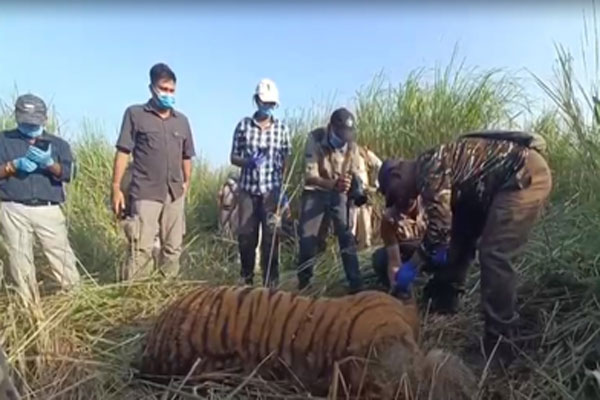
Kaziranga National Park and Tiger Reserve in Assam reported two wildlife deaths within a short span, with a sub-adult tiger succumbing to injuries from an animal fight and a departmental elephant dying from age-related complications.
At A Glance
-
Forest officials recovered a two-day-old carcass of a sub-adult tiger from the Teteliguri area under Kaziranga’s Kohora Range.
-
Preliminary findings suggest that injuries sustained during a fight with other animals caused the tiger’s death.
-
Departmental elephant Krishna died in Bagori after prolonged illness, with preliminary findings pointing to age-related hepato-renal failure.
Forest officials have recovered the carcass of a sub-adult tiger from Assam’s Kaziranga National Park and Tiger Reserve (KNPTR). The discovery in the Teteliguri area has raised fresh concerns over wildlife deaths in the renowned protected area. Preliminary findings indicate that injuries sustained during a fight with other animals caused the tiger’s death.
The recovery took place on Friday under the Kohora Range of the national park. Forest officials estimated that the carcass was around two days old.
In a separate incident, a departmental elephant named Krishna died inside the Western Range of Bagori on Thursday evening. The female elephant had suffered from prolonged health problems and visual impairment.
The two deaths have once again brought attention to wildlife mortality inside the national park, which supports several endangered and iconic species.
Committee Formed for Tiger Post-Mortem
A senior forest official said KNPTR Director Sonali Ghosh had constituted a committee to conduct the post-mortem examination of the tiger.
The committee will also oversee the disposal of the carcass. It will follow the Standard Operating Procedure (SOP) prescribed by the National Tiger Conservation Authority (NTCA).
Preliminary findings suggest that the tiger sustained fatal injuries during a fight with other animals.
The forest department will follow the prescribed procedures to complete the post-mortem examination and dispose of the carcass.
Tiger Infighting Among Previous Causes of Death
Kaziranga has witnessed similar incidents in the past, with forest officials recovering tiger carcasses from different parts of the reserve.
Post-mortem examinations in most of those cases indicated that fights among tigers caused the deaths.
Territorial disputes and confrontations among animals can result in fatal injuries. However, the preliminary assessment in the latest case points to a fight with other animals as the likely cause.
The latest recovery adds to the previous instances of tiger mortality reported from different areas of the national park.
Ailing Departmental Elephant Krishna Dies in Bagori
In another wildlife-related incident, a departmental elephant named Krishna died on Thursday evening inside the Western Range of Bagori.
According to a senior forest official, the female elephant had been suffering from prolonged ailments. She also had visual impairment.
A team of veterinarians from Kaziranga National Park and the Centre for Wildlife Rehabilitation and Conservation (CWRC) conducted a post-mortem examination on Friday.
The preliminary report identified hepato-renal failure associated with old age as the cause of death.
The findings indicate that age-related health complications led to the elephant’s death. The official confirmed the preliminary assessment following the post-mortem examination.
Kaziranga Houses India’s Famous Big Five Wildlife Species
Kaziranga National Park and Tiger Reserve holds a prominent place among India’s protected wildlife areas. Recognised as the country’s seventh UNESCO World Heritage Site, it shelters several important wildlife species.
The reserve is home to India’s famed ‘Big Five’ wildlife species: the greater one-horned rhinoceros, Bengal tiger, Asian elephant, wild water buffalo and eastern swamp deer.
The latest available population estimates highlight the park’s rich biodiversity.
According to the 2022 census, Kaziranga has 2,613 greater one-horned rhinoceroses and 104 Bengal tigers. The same census recorded 2,565 wild water buffaloes and 1,129 eastern swamp deer.
An estimate released in 2024 placed the park’s Asian elephant population at 1,228.
These figures underline Kaziranga’s importance as a major habitat for some of India’s most significant wildlife species.
KNPTR Records Higher Revenue in 2024-25
Kaziranga National Park and Tiger Reserve extends across four Assam districts: Golaghat, Nagaon, Sonitpur and Biswanath.
The protected area has also recorded growth in revenue collection over the past two financial years.
KNPTR generated more than Rs 10.90 crore in revenue during 2024-25. This marked an increase from the over Rs 8.81 crore collected in 2023-24.
The reserve operates through three forest divisions.
These are the Eastern Assam Wildlife Division, headquartered at Bokakhat; the Biswanath Wildlife Division, based at Biswanath Chariali; and the Nagaon Wildlife Division, headquartered at Nagaon.
Together, these divisions oversee the administration of the vast protected area, which remains one of India’s most important centres for wildlife conservation.