

The Chintan Research Foundation (CRF), in collaboration with two universities in Guwahati, organised academic discussions on November 4 and 5 to examine how Northeast India could strengthen its strategic and economic role between South and Southeast Asia through regional connectivity, border governance and cross-border cooperation.
At A Glance
-
Experts call for a greater role for Northeast India in shaping India’s foreign policy and regional partnerships.
-
Bangladesh connectivity, the Siliguri Corridor and major regional infrastructure projects dominate discussions in Guwahati.
-
Participants stress inclusive development, stronger border governance and greater involvement of frontier communities.
Northeast India must move beyond its traditional identity as a transit corridor and emerge as an active participant in shaping India’s regional diplomacy and economic integration with South and Southeast Asia, experts said during a two-day series of academic discussions in Guwahati.
The discussions highlighted the region’s growing geopolitical importance, strategic location and potential to become a major gateway for regional connectivity. Participants also stressed that infrastructure expansion alone would not transform Northeast India into a regional economic hub. Stronger diplomatic engagement, effective border governance and inclusive development must complement connectivity initiatives.
The Chintan Research Foundation (CRF) organised the academic engagements on November 4 and 5 under the theme “Northeast India in a Changing Geopolitical Order: Connectivity, Borderlands, Frontier Governance and Strategic Opportunities”.
CRF conducted the first engagement in collaboration with Girijananda Chowdhury University (GCU) and the second with Assam Don Bosco University (ADBU).
Experts Seek Greater Role for Northeast India in Foreign Policy
Participants argued that policymakers must stop viewing Northeast India merely as a geographically distant region or a passage for transporting goods and people.
Instead, they called for a greater role for the region in shaping India’s relations with neighbouring countries and the wider international community.
Northeast India’s proximity to Bangladesh, Bhutan, Myanmar and other Southeast Asian nations offers considerable opportunities for cross-border trade, transport connectivity, energy cooperation and people-to-people exchanges.
However, experts cautioned that policymakers must consider these opportunities alongside challenges involving border security, migration, infrastructure gaps and border management. They also stressed the need to address the expectations and concerns of communities living in frontier areas.
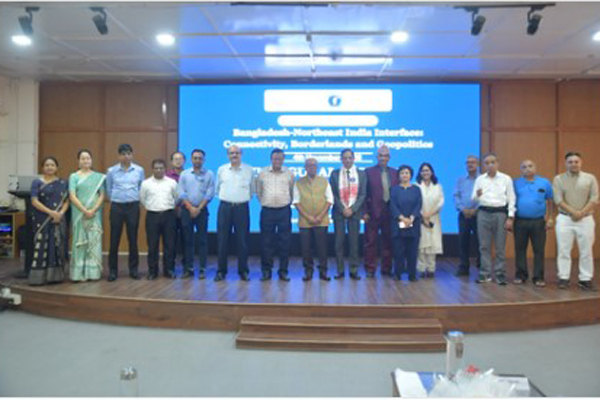
Addressing a one-day dialogue at GCU titled “Bangladesh-Northeast India Interface: Connectivity, Borderlands and Geopolitics”, CRF President Shishir Priyadarshi emphasised the importance of sustained engagement with Bangladesh.
He advocated what he called the “Woodpecker Approach”, highlighting the importance of patience, persistence and continuous efforts in bilateral relations.
Priyadarshi also outlined CRF’s contribution to research and constructive dialogue. He called for stronger representation of Northeast India’s perspectives in India’s foreign policy formulation.
Bangladesh Connectivity and Bay of Bengal in Focus
Panel discussions examined Bangladesh’s strategic importance in improving connectivity with Northeast India.
Participants discussed the potential of Bangladesh’s seaports, inland waterways and cross-border transport networks to strengthen regional trade and economic cooperation.
The discussions also covered the Bay of Bengal’s growing geopolitical significance, the involvement of external powers and opportunities for economic partnerships across border regions.
The second-day seminar at ADBU focused on “India’s Northeast in a Changing Geopolitical Order: Connectivity, Frontier Governance and Strategic Opportunities”.
ADBU Vice Chancellor Jose Palely stressed the need to view international borders as spaces for economic activity and social engagement rather than merely territorial divisions.
He emphasised that communities living along international borders must receive due recognition as important partners in governance and development.
Akhaura-Agartala Link, Kaladan Project Feature in Discussions
Both academic engagements examined major infrastructure initiatives that could strengthen regional connectivity.
The discussions covered the Akhaura-Agartala railway link, access to Bangladesh’s seaports, inland waterways and road infrastructure.
Participants also examined two major regional initiatives: the India-Myanmar-Thailand Trilateral Highway and the Kaladan Multi-Modal Transit Transport Project.
Experts stressed the need to improve connectivity within Northeast India while modernising border infrastructure. They also called for streamlined customs procedures and better coordination among the institutions responsible for cross-border transport and trade.
The possibility of developing alternative transport routes through Bangladesh also received attention.
In particular, participants discussed the Agartala-Kolkata road connection as a possible alternative to India’s heavy dependence on the Siliguri Corridor for connecting the Northeast with the rest of the country.
Such alternative routes could provide additional connectivity options and strengthen the region’s economic links with neighbouring countries.
China, Water Security and Siliguri Corridor Raise Strategic Concerns
The geopolitical discussions also examined several security and strategic challenges affecting Northeast India.
Participants discussed China’s expanding strategic footprint in the region and concerns surrounding water security, particularly the Yarlung Tsangpo River.
The strategic importance of the Siliguri Corridor also featured prominently in the discussions.
Other subjects included cross-border drug trafficking and changing political circumstances in Myanmar and Bangladesh.
Experts emphasised the importance of India’s Act East and Neighbourhood First policies in strengthening regional engagement.
However, they stressed that connectivity projects must generate measurable economic and developmental benefits for people living in Northeast India.
They also highlighted opportunities to expand regional cooperation through multilateral platforms such as the Bay of Bengal Initiative for Multi-Sectoral Technical and Economic Cooperation (BIMSTEC).
Border Communities Must Benefit From Regional Integration
Participants called for greater involvement of Northeastern states in shaping India’s engagement with neighbouring countries.
They advocated stronger institutional partnerships and greater participation by state governments through para-diplomacy.
Experts maintained that Northeast India should not remain merely a connecting link between India and neighbouring countries. Instead, the region must become one of the principal beneficiaries of cross-border cooperation and regional economic integration.
The discussions concluded with an emphasis on adopting a comprehensive approach to transform Northeast India into a strategic gateway between South and Southeast Asia.
Participants stressed that infrastructure development alone would not achieve this objective. Sustained diplomatic engagement, efficient frontier governance, stronger regional partnerships and inclusive economic development would also remain essential.
They further underlined the importance of involving border communities in decisions that shape the region’s future.
The two-day engagements thus highlighted a central concern: Northeast India must have a greater voice in regional cooperation and foreign policy while directly benefiting from the economic opportunities created by its strategic location. (Edited by Enewstime Desk)