

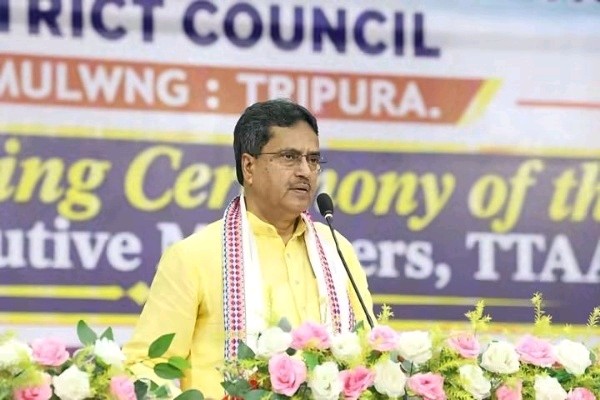
CM Dr Manik Saha pitches for administrative cooperation from the TTAADC with the objective of improving living conditions in tribal-dominated areas.
At A Glance:
-
Chief Minister Dr Manik Saha called for coordinated efforts between the state government and TTAADC to improve living standards in tribal areas.
-
He urged newly appointed Executive Members to ensure transparency, accountability and administrative efficiency.
-
The government is considering residential education facilities, improved drinking water systems and stronger healthcare services for TTAADC areas.
Chief Minister Dr Manik Saha has called for stronger institutional cooperation between the Tripura government and the Tripura Tribal Areas Autonomous District Council (TTAADC), saying neither institution can achieve meaningful development by working independently.
Addressing the swearing-in ceremony of newly appointed TTAADC Executive Members (EMs) at Nuai Auditorium in Khumulwng on Tuesday (November 10), he stressed that both institutions must work together to improve the living standards of people in tribal-dominated areas.
He urged the new Executive Members to make public welfare their primary responsibility. Transparency, accountability and administrative efficiency must guide the council’s functioning, he said.
Lok Sabha MP Kriti Singh Debbarma, Tipra Motha founder Pradyot Kishore Manikya Debbarma, veteran tribal leaders Bijoy Kumar Hrangkhawl and Jagadish Debbarma, Tribal Welfare Minister Bikash Debbarma and TTAADC Chief Executive Member Runiel Debbarma attended the programme.
MLAs, Executive Members, MDCs, Chief Executive Officer C. Murthy, the Law Secretary, the Tribal Welfare Department Secretary and other officials were also present.
CM Calls for Trust Between State Government and TTAADC
Dr Saha said mutual trust and effective communication were essential for maintaining a productive relationship between the state government and the autonomous district council.
He acknowledged that disagreements and different demands could emerge during the administration of tribal areas. However, he said authorities must examine the practical feasibility of every demand before considering its implementation.
The government wanted to resolve problems through discussion rather than allow differences to create divisions, he said.
Explaining the importance of the Sixth Schedule, the Chief Minister said it protects tribal land rights, languages, culture, traditions, customs and socio-economic interests. It also guarantees constitutional provisions for self-governance.
He said the framework allows tribal communities to preserve their distinct identity while safeguarding their rights.
“TTAADC and the Tripura Government complement each other. Neither institution can function effectively without the other. Development is not possible if we work separately,” Dr Saha said.
He called for joint planning and coordinated implementation of development programmes across tribal areas.
CM Praises Pradyot’s Commitment to Tiprasa Community
The Chief Minister also referred to Pradyot Kishore Manikya Debbarma’s decision to step away from active electoral politics.
He said withdrawing from formal politics did not mean distancing oneself from public life. Dr Saha appreciated Pradyot’s assurance that he would continue supporting the Tiprasa community through their happiness and difficulties.
The Chief Minister assured TTAADC leaders and tribal representatives that his doors would always remain open for discussions and resolving their concerns.
He also pointed out that better communication and mutual understanding could help achieve significant progress without depending entirely on additional financial resources.
Drinking Water Coverage Reaches 86%
Highlighting the state’s drinking water programme, Dr Saha said household tap water coverage had increased from around three per cent to 86 per cent.
However, he acknowledged that geographical difficulties continued to affect water supply in remote and hilly tribal areas.
The government was exploring alternative water purification and distribution systems, along with modern technologies, to address these challenges.
He said the objective was to ensure drinking water access for every household, including those in difficult-to-reach locations.
Government Considers Residential Schools for Tribal Students
Education was another major area highlighted by the Chief Minister.
Dr Saha said the government had formed a special committee to examine the problems of schools in TTAADC areas where student enrolment remained extremely low.
Authorities were considering converting certain schools into residential educational institutions if suitable infrastructure was available within a distance of one to two kilometres. The proposal particularly concerns schools that have teachers but very few students.
The Chief Minister also outlined plans to develop better residential education facilities for tribal students, with accommodation and food arrangements similar to those provided by Eklavya Model Residential Schools.
He stressed that the initiative would require close cooperation between the state government and the TTAADC.
Dr Saha further emphasised the need to preserve tribal traditions, Indian culture and Tripura’s rich cultural heritage among younger generations.
Healthcare Benefits Must Reach TTAADC Residents
On healthcare, the Chief Minister said residents of autonomous district council areas must receive the benefits of improvements in the state’s health infrastructure and medical services.
Referring to the Mukhyamantri Jan Arogya Yojana and Pradhan Mantri Jan Arogya Yojana, he claimed that Tripura had succeeded in bringing the entire population under health insurance coverage.
He stressed that healthcare improvements must reach people in remote tribal areas as well.
CM Proposes Stronger Institutional Support for TTAADC
Dr Saha also proposed expanding institutional cooperation to make the TTAADC stronger and more responsive to public needs.
He indicated that the state government could support the council by sharing or transferring responsibilities in selected administrative and development-related areas.
The Chief Minister acknowledged that administrative mistakes could occur. However, he said timely corrections, financial discipline and a well-organised administrative system were essential to maintaining public confidence.
He urged the newly appointed Executive Members to prioritise transparency, accountability and administrative efficiency.
Concluding his address, Dr Saha reiterated that the state government and the TTAADC were inseparable partners in Tripura’s development. He assured the new Executive Members of all possible cooperation from the state government and wished them success in their responsibilities.
