

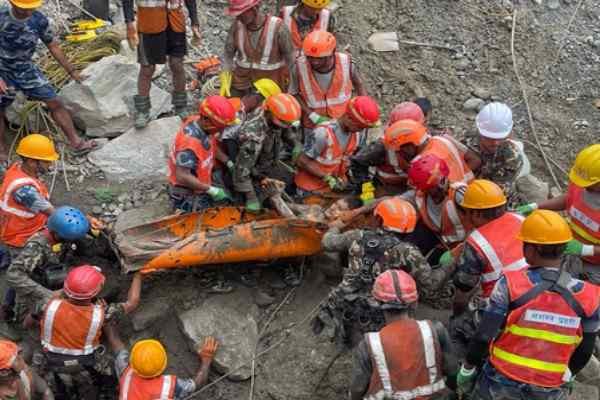
Two workers trapped inside a flood-damaged tunnel at Trishuli 3A Hydropower Project in Nepal were rescued alive on Friday, nine days after a devastating flash flood tore through the Trishuli River corridor. The breakthrough has raised fresh hopes for finding other survivors as rescue teams continue searching damaged hydropower facilities.
Key Takeaways:
- Two workers were rescued alive from the Trishuli 3A Hydropower Project nine days after devastating floods hit Nepal.
- Rescue teams had earlier established communication after hearing voices from inside the tunnel.
- The disaster has killed at least 1,252 people, while 5,053 remain missing, according to NDRRMA.
Two workers trapped inside a tunnel at Trishuli 3A Hydropower Project were rescued alive on Friday, nine days after a devastating flash flood struck the Trishuli River corridor in Nepal.
The dramatic rescue came after search teams detected voices from inside the tunnel and established contact with people believed to be trapped there. The breakthrough has raised hopes that other missing workers could also be alive inside damaged hydropower facilities.
The rescued workers were identified as 45-year-old Kabir Maharjan of Kathmandu and 30-year-old Sanjaya Sah of Saptari district.
Two Workers Pulled Out Alive
According to the Secretariat of the Minister for Energy, Water Resources and Irrigation, Maharjan serves as a supervisor with the Hydropower Automation Project of Upper Trishuli 3A.
Sah works as a foreman at the project.
Rescue officials brought Sah out of the tunnel first on Friday. Maharjan was rescued later during the operation.
The two men were subsequently airlifted and taken to a hospital in Kathmandu for medical treatment, the minister’s secretariat said.
Their rescue marked a major breakthrough in an operation that had faced severe challenges because of the extensive damage caused by the floods.
Voices Led Rescuers to Trapped Workers
The rescue operation gained momentum after personnel heard voices coming from inside the tunnel.
Rescuers then established communication with the people believed to be trapped inside. Personnel from the Nepal Army and Armed Police Force intensified their efforts after confirming signs of life.
Local media reports said rescue personnel repeatedly called out to the trapped workers and asked them to remain calm.
The teams then worked to clear a route into the tunnel. Their efforts eventually enabled them to reach and evacuate the two workers.
Flash Flood Left Thousands Missing
The rescue took place nine days after a powerful flash flood swept through the Trishuli River valley on August 26.
The disaster caused widespread destruction along the river corridor. It also damaged hydropower projects, roads and other critical infrastructure.
According to the latest situation report from the National Disaster Risk Reduction and Management Authority (NDRRMA), at least 1,252 people had died in the disaster.
A further 5,053 people remained missing as of Thursday evening.
The scale of the devastation has made the search for survivors particularly difficult. Rescue teams have been examining tunnels and other damaged structures where people could remain trapped.
Army, Armed Police and Chinese Experts Join Search
A joint team from the Nepal Army and Armed Police Force has been deployed at the Trishuli 3A site.
Chinese experts are also supporting the rescue operation, according to the energy ministry’s secretariat.
The teams are using five excavators, compressors and breakers to remove debris and open access routes.
They have also intensified drilling and tunnel-holing work to reach sections that remain inaccessible.
A major obstacle emerged when rescuers found a large rock inside the tunnel.
The teams carried out blasting work to remove the obstruction. Clearing the rock allowed them to advance the search and rescue operation further into the tunnel.
Hydropower Sector Suffers Heavy Damage
The Trishuli 3A hydropower plant was among the power projects affected by flooding in the Trishuli and Bhotekoshi river systems.
The floods caused extensive damage to hydropower infrastructure across the region. Several important road links were also damaged, complicating rescue and relief operations.
The Independent Power Producers’ Association, which represents private-sector power developers, reported another major concern on Thursday evening.
The association said 945 people working across 11 hydropower projects affected by the floods remained out of contact.
The figure highlights the scale of the challenge facing rescue teams across Nepal’s flood-hit hydropower sector.
Fresh Hope for More Survivors
The rescue of Maharjan and Sah has given a significant boost to ongoing search operations.
Their survival nine days after the floods demonstrates the possibility that other missing workers could still be alive in isolated sections of damaged infrastructure.
Rescue teams are therefore continuing efforts to reach inaccessible tunnels and other structures.
For families waiting for news of missing relatives, the successful evacuation of the two workers has provided a renewed measure of hope.
Authorities are expected to maintain the search as teams work through damaged infrastructure and difficult terrain to locate those who remain unaccounted for.