

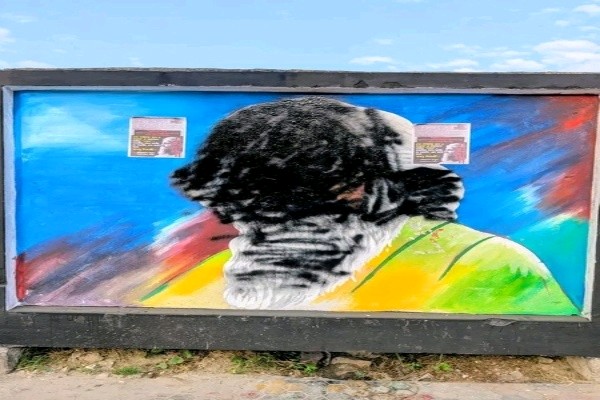
Unidentified miscreants vandalized a portrait of Nobel laureate Rabindranath Tagore at Khulna Railway Station in Bangladesh on Sunday, November 22. For the second time this month, such vandalism occurred. Police launched an investigation amid cultural activists’ suspicions of an organised campaign targeting the country’s cultural icons.
At A Glance
-
Rabindranath Tagore’s wall portrait at Khulna Railway Station was defaced with black ink for the second time this month.
-
Cultural activists suspect an organised group and have demanded the identification and prosecution of those responsible.
-
At least 37 prominent Bangladeshi citizens previously warned that attacks on Tagore’s murals could encourage religious extremism and deepen communal tensions.
A renewed attack on a portrait of Nobel laureate Rabindranath Tagore at Khulna Railway Station has triggered fresh outrage in Bangladesh, raising concerns over repeated acts of vandalism targeting the country’s cultural icons.
Unknown miscreants smeared the mural with black ink just days after authorities restored it following an earlier attack.
The latest incident came to light on Sunday, marking another instance of vandalism against Tagore’s portrait within the same month. The repeated targeting has alarmed cultural activists and local residents, who fear that other prominent personalities could also become targets.
Police Begin Probe Into Repeated Vandalism
Confirming the incident, Lokman Hossain, officer-in-charge of Khulna Sadar Police Station, said police personnel were being sent to the location to investigate and identify those involved.
According to local media reports, the portraits were created on a wall opposite the Khulna Development Authority (KDA) building under an urban beautification initiative undertaken by Khulna City Corporation (KCC).
The mural features several distinguished personalities from Bangladesh’s cultural and literary history. These include National Poet Kazi Nazrul Islam, folk mystic Fakir Lalon Shah, artist SM Sultan and poet Michael Madhusudan Dutt.
However, Tagore’s portrait alone was targeted with black spray paint, making the incident particularly concerning for cultural circles.
Cultural Activists Suspect Organised Group
The same portrait had suffered a similar attack earlier this month when unidentified individuals smeared it with black ink. The incident prompted widespread criticism from residents and cultural activists.
Reacting strongly to the latest vandalism, KCC Administrator Nazrul Islam Manju condemned the act and criticised those responsible for targeting the literary icon.
He said the defacement reflected the perpetrators’ narrow-mindedness and what he described as a sick mentality.
Shariful Islam Salim, a cultural activist and general secretary of Nattyalok, expressed suspicion that an organised group was orchestrating such incidents.
He pointed out that similar acts of vandalism had also occurred in Dhaka. According to Salim, the repeated attacks appeared deliberate and required a serious investigation.
He demanded that the authorities identify those responsible and ensure they face legal consequences. He also cautioned that the attacks might not remain limited to Tagore, warning that other eminent personalities could become targets.
Tagore’s Cultural Legacy Under Threat
Salim emphasised that Tagore’s literary works and philosophy had influenced generations by promoting independent thinking, secularism and human dignity.
He expressed concern that some young people were being misguided into participating in acts that undermine Bangladesh’s cultural heritage.
Describing Tagore as an inseparable part of the country’s cultural identity and a lasting source of inspiration, Salim appealed to people across society to unite against those responsible for the vandalism.
Earlier Attack on Tagore Mural in Dhaka
The latest incident follows another attack on a Tagore mural in Dhaka last month. Unknown individuals defaced a graffiti portrait of the Nobel laureate outside the Bangladesh Shilpakala Academy by applying black ink.
The incident prompted at least 37 prominent Bangladeshi citizens to issue a statement expressing serious concern over the growing attacks on Tagore’s representations.
The signatories warned that repeated incidents of this nature could strengthen religious extremist elements and aggravate communal tensions across Bangladesh.
They also recalled the political campaign against Tagore during the 1960s, when Pakistan’s rulers portrayed the poet as anti-Muslim. The signatories drew parallels between that historical campaign and the recent vandalism targeting his portraits.
The repeated attacks have therefore renewed concerns about the treatment of Bangladesh’s cultural heritage and the need to protect its prominent literary and artistic figures. (Edited by Enewstime Desk)