

Former TERC Chairman D Radhakrishna has urged the Centre to introduce nationwide electrical safety reforms. In a letter to NITI Aayog Member Prof Abhay Karandikar, he proposed stronger monitoring, safety audits, skill development and tariff reforms to protect consumers and improve India’s power sector.
Quick Glance
- Former Tripura Electricity Regulatory Commission (TERC) Chairman D Radhakrishna seeks major electrical safety reforms.
- He highlighted risks from transformer blasts, short-circuit fires and electrocution incidents.
- Suggested independent safety certification, regular audits and a national electrical safety authority.
- Proposed examining a 40-year tariff framework for long-life power infrastructure projects.
Mumbai/New Delhi: Former power sector regulator D Radhakrishna has called for a nationwide review of electrical safety standards amid growing concerns over accidents, fire incidents and electrocution cases across India.
Radhakrishna, who served as the Former Chairman of Tripura Electricity Regulatory Commission (TERC), Agartala, submitted a series of recommendations to NITI Aayog Member Prof Abhay Karandikar on June 9, 2026. His suggestions focus on improving electrical safety management, strengthening monitoring systems and creating a safer power ecosystem.
He also served as the Former Chairman of the State RERA Appellate Tribunal, Agartala, Former Chairman of the Forum of North East & Eastern State Regulatory Commission, Bhubaneswar, and Former Vice Chairman of the Forum of Indian Regulators, New Delhi.
Radhakrishna said electrical safety has remained one of the most important yet overlooked areas of India’s rapidly changing power sector. According to him, rising electricity demand, urban expansion, high-rise construction, industrial growth and increased dependence on electrical appliances have created fresh safety challenges.
Electrical Accidents Raise Safety Concerns Across India
Electrical failures continue to affect households, commercial buildings and public infrastructure. Transformer explosions, short-circuit fires and electrocution incidents frequently create safety risks for citizens.
Radhakrishna recalled a tragic incident from 1984 when a circuit-breaker blast at a power generation facility reportedly claimed nearly 20 lives, including his colleagues. He said the incident highlighted the importance of preventive safety measures and strict compliance with technical standards.
He stressed that modern power expansion must move together with stronger safety systems. The growing use of electricity in residential areas, industries and public facilities requires continuous inspection and professional management.
Key Safety Reform Proposals
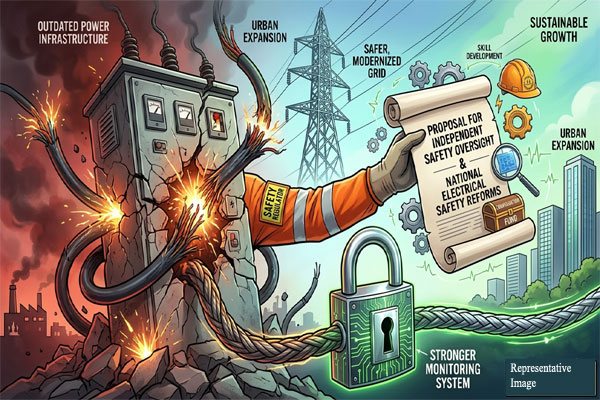
Radhakrishna recommended an independent electrical safety certification system to improve accountability and compliance. He suggested involving accredited third-party agencies, technical institutions and professional organisations in safety inspections.
His major recommendations include:
| Proposed Reform | Purpose |
|---|---|
| Independent electrical safety certification | Ensure compliance with safety standards |
| Mandatory safety audits | Identify risks in buildings and infrastructure |
| Scientific load assessment | Prevent electrical overload and failures |
| Stronger CEA regulation enforcement | Improve implementation of safety rules |
| National Electrical Safety Manual | Provide standard guidelines across sectors |
He suggested mandatory electrical safety audits for residential complexes, hospitals, schools, malls, industries and high-rise buildings.
According to him, regular inspections and preventive maintenance can reduce electrical failures and protect consumers.
Proposal for National Electrical Safety Authority
The former regulator recommended establishing a dedicated national-level authority for electrical safety oversight.
The proposed body could monitor safety practices, investigate electrical accidents and coordinate policy measures across states.
Radhakrishna said such an authority would help identify recurring causes behind electrical accidents and develop long-term solutions.
He also highlighted the need for better training programmes for electricians, maintenance workers and field-level technical staff.
Skill development, certification and awareness campaigns, he said, can improve safety standards at the grassroots level.
Compensation Support for Accident Victims
Radhakrishna also suggested improving compensation mechanisms for victims of electrical accidents and fire incidents.
He emphasised that affected families require timely assistance after electrical tragedies. A stronger support framework could provide financial relief and improve public confidence in safety systems.
40-Year Tariff Framework Suggested for Long-Life Projects
Apart from electrical safety reforms, Radhakrishna suggested reviewing the tariff structure for major power infrastructure projects.
He argued that several assets, including hydroelectric projects and other long-life electricity facilities, can operate efficiently beyond the conventional tariff recovery period.
He proposed examining a 40-year tariff framework for suitable projects.
| Area | Proposed Approach |
|---|---|
| Long-life power assets | Extended tariff planning |
| Consumer benefit | Reduced pressure on electricity costs |
| Infrastructure maintenance | More financial flexibility |
| Safety compliance | Better investment capacity |
Radhakrishna said a longer tariff cycle could balance consumer affordability with the financial needs of maintaining ageing infrastructure.
Call for Expert Committee on Power Sector Reforms
Radhakrishna urged the government to create a high-level committee involving regulators, technical experts, academic institutions and industry representatives.
The committee could examine electrical safety reforms and tariff restructuring proposals in detail.
He said India’s power sector is entering a new phase with renewable energy expansion, smart grids, electric mobility and increasing electrification.
According to him, safety and affordability should remain the two main pillars of future electricity reforms.
The recommendations aim to build a safer, reliable and consumer-focused power system capable of meeting India’s future energy requirements.
People Also Ask (FAQ)
Q1. Who is D Radhakrishna?
Ans: D Radhakrishna is a former Chairman of the Tripura Electricity Regulatory Commission (TERC) and has held several senior regulatory positions in India’s power sector.
Q2. What electrical safety reforms did Radhakrishna suggest?
Ans: He suggested independent safety certification, mandatory audits, stronger enforcement of safety rules, a national safety authority and better training for electrical workers.
Q3. Why did Radhakrishna suggest a 40-year tariff framework?
Ans: He suggested a longer tariff framework for long-life power projects to improve affordability and provide financial support for maintenance and safety compliance.
