

While granting nationwide relief from protest-related FIRs, the SC has allowed Delhi Police to pursue a separate case against 2,873 people.
Key Takeaways
- The Supreme Court allowed Delhi Police to register one FIR against 2,873 people linked to the Jantar Mantar protests.
- The proposed case will focus only on bodily harm and property damage.
- Other FIRs linked to the July 20–25 student protests will not be pursued across India.
The Supreme Court on Tuesday permitted Delhi Police to register a single FIR against 2,873 people who were present during the Jantar Mantar student protests and were identified as having serious criminal antecedents.
The decision came as the apex court closed FIRs connected with student protests held between July 20 and 25 across the country. The court also barred states and Union Territories from pursuing or investigating similar cases arising from those demonstrations.
However, the relief comes with an important exception. Delhi Police can investigate the 2,873 individuals through one consolidated FIR.
Why the 2,873 protesters are an exception
The Supreme Court made a distinction between students facing cases because of their participation in the protests and people allegedly linked to serious criminal activity.
The 2,873 individuals were present at the Jantar Mantar demonstrations. Delhi Police had sought permission to register a fresh and specific FIR against them based on their alleged criminal antecedents.
The court accepted the request but imposed strict limits on the proposed case.
The FIR cannot become a broad investigation into every aspect of the protests. It must remain confined to allegations involving bodily harm and destruction of property.
This restriction gives the court order a two-tier character. Most student protesters receive protection from further criminal proceedings. Those covered by the exception can still face investigation for specified acts.
Nationwide FIR relief remains intact
The Supreme Court directed that FIRs related to the July 20–25 protests in any state or Union Territory should not be pursued or investigated.
Cases registered in states that were not directly part of the applications before the court will also receive the same relief.
The court further ordered that authorities must treat such cases as closed. It also prohibited states and Union Territories from registering fresh FIRs over incidents arising from the protests during the specified period.
The order therefore extends beyond Delhi. It provides nationwide protection to protesters who do not fall within the specific exception created by the court.
Delhi Police sought a separate investigation
The exception follows a request from Delhi Police.
The force had earlier told the Supreme Court that it did not want to continue with 13 FIRs linked to the July protests. At the same time, it sought permission to register a fresh case against 2,873 people with serious criminal antecedents. (Source: India Today)
Reports before the court indicated that police had identified a large group of people whose backgrounds required separate scrutiny.
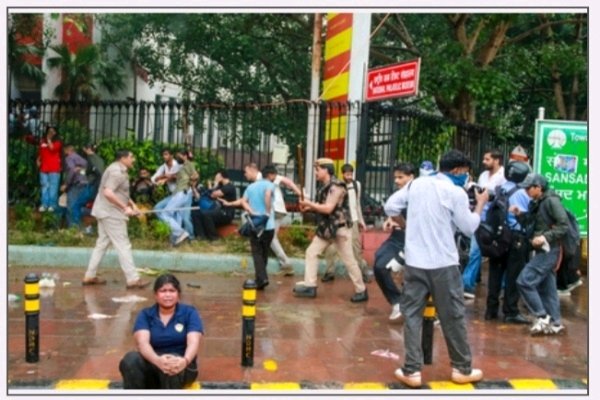
The proposed FIR was therefore designed to separate alleged serious offenders from students who took part in the demonstrations.
Court keeps focus on violence and property damage
The Supreme Court has also defined the boundaries of the fresh FIR.
Delhi Police cannot use the permission as a basis for reopening every allegation connected with the protests.
The court specifically limited the proposed case to physical harm and damage to property.
It also clarified that the individuals concerned would retain their right to seek remedies available under law.
This means the Supreme Court has offered broad relief while retaining a legal route for investigating allegations involving violence and destruction.
Article 142 gives wider relief
The Bench headed by Chief Justice of India Surya Kant invoked its extraordinary powers under Article 142 of the Constitution.
The court said it was exercising the power after considering the future prospects of young protesters who had participated in the demonstrations.
The Bench also made an important legal clarification. Its use of Article 142 was based on the particular facts and circumstances of the case. It should not be treated as a general precedent for other cases.
CJP withdraws September 5 march
The Supreme Court’s decision also changed the political trajectory of the dispute.
CJP co-convener Saurav Das, who was present during the hearing, announced that the organisation would withdraw its proposed September 5 protest march.
The decision followed assurances from the Centre and the Supreme Court’s order on the FIRs. (Live Law)
The CJP had announced the march on August 24. It had planned to move from India Gate to the New Delhi Police Headquarters.
The proposed demonstration was linked to demands concerning cases against student protesters and commitments made by the government.
The Supreme Court’s latest order has now removed most of the criminal cases from the dispute, while keeping the 2,873-person exception under a separate legal track. (Edited by Enewstime Desk)