

For thousands of women in Arunachal Pradesh, the rural economy is no longer limited to traditional livelihoods. The state government is building a network of collective enterprises around them. Chief Minister Pema Khandu says nearly 1.50 lakh women have joined Self-Help Groups over the past decade, including women from some of the state’s most remote villages.
Key Takeaways
- Nearly 1.50 lakh women in Arunachal Pradesh have joined the Self-Help Group movement over the past decade.
- The government is using SHGs, FPOs and farmer producer companies to strengthen rural entrepreneurship.
- Chief Minister Pema Khandu has called for better training, technical knowledge, value addition and market access for farmers.
The figure puts women at the centre of Arunachal Pradesh’s broader effort to strengthen agriculture and allied activities.
Khandu said the government has given special priority to agriculture and allied sectors since 2019. The approach brings Agriculture, Horticulture, Fisheries and Animal Husbandry into closer coordination.
But the government’s strategy goes beyond production.
It is also about organisation.
SHGs have become one of the platforms through which rural women can receive training and pursue livelihood and business activities. The government has also promoted Farmer Producer Organisations (FPOs), Farmer Producer Companies and other collective enterprises.
The idea is straightforward. A farmer working alone has limited reach. A collective can seek institutional support, connect with banks and engage more professionally with markets.
Khandu said these platforms should help farmers and rural entrepreneurs manage their businesses more effectively.
1.5 Lakh Women Linked to SHG Movement
The Chief Minister said nearly 1.50 lakh women have been associated with the SHG movement in Arunachal Pradesh during the past decade.
The significance of the number lies not only in its scale.
It also reflects the spread of the programme into remote parts of the state.
Khandu said women in even distant villages have received training and taken up different livelihood and business activities.
That expansion forms an important part of the state’s attempt to make rural economic activity more organised.
The government has also facilitated FPOs and farmer producer companies across districts. These bodies are intended to improve farmers’ access to government schemes, banking facilities and professional business opportunities.
From Farming to Value Addition
Khandu’s larger message is that agriculture cannot remain only about growing crops.
Farmers also need knowledge of what comes after production.
He said Arunachal farmers are hardworking but require greater technical knowledge, stronger market connections and professional guidance on value addition.
That is where training becomes crucial.
The Chief Minister stressed the need for continuous training of departmental officials. He said officials must be able to guide farmers on modern technologies, government schemes and emerging opportunities.
The state’s diverse geography makes that task particularly important.
Arunachal Pradesh stretches from tropical and subtropical foothill areas to temperate and alpine zones. Khandu said this diversity gives the state considerable potential in agriculture and horticulture.
The challenge is to convert that natural advantage into sustainable income.
New Facility to Support Farmers
The government is also seeking to strengthen the training infrastructure.
Khandu recently inaugurated the State Agriculture Information Hub-cum-Farmers’ Hostel at Naharlagun. He also flagged off the Matsya e-Vaahini and e-Rickshaw.
The hostel is expected to provide accommodation for farmers attending specialised programmes.
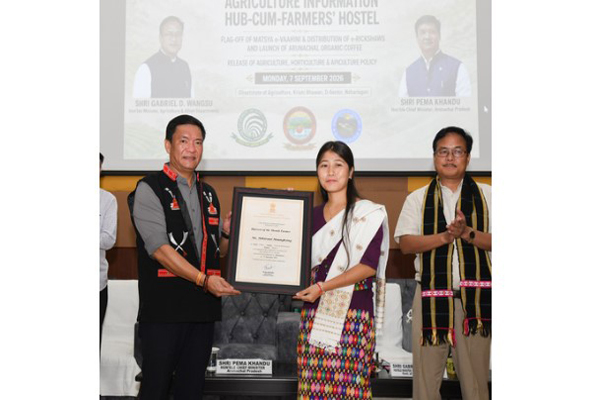
Khandu said farmers could stay there while participating in week-long or longer training sessions focused on particular crops and allied activities.
He urged the Agriculture, Horticulture, Fisheries and Animal Husbandry departments to make full use of the facility.
The programmes, he said, should reflect Arunachal Pradesh’s specific agricultural challenges and opportunities.
Building Rural Businesses, Not Just Livelihoods
The distinction matters.
A livelihood can sustain a household. An organised rural enterprise can potentially create a larger economic chain.
That is why the government is emphasising SHGs, FPOs and farmer producer companies alongside technical training and market access.
Khandu asked officials to identify leading experts from across the country and expose farmers to modern technologies and technical know-how.
He also stressed value addition and market-oriented farming.
| More Northeast News Here |
For Arunachal Pradesh, the policy challenge is therefore not simply to increase agricultural activity. It is to make rural production more organised, commercially viable and sustainable.
The state’s growing network of women-led SHGs is a significant part of that effort.
With nearly 1.50 lakh women linked to the movement over the past decade, the government is betting that collective organisation can become a stronger foundation for rural entrepreneurship across Arunachal Pradesh. (With IANS inputs)
