

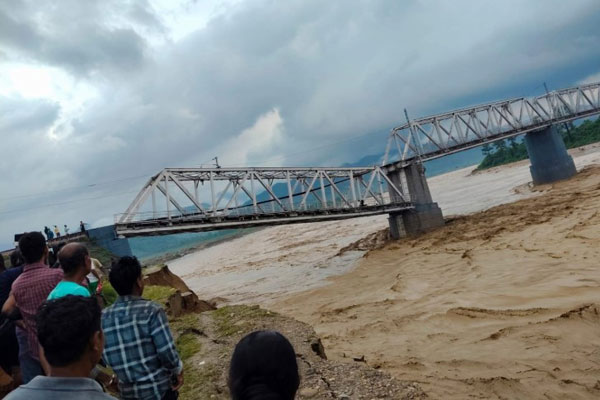
River erosion triggered by continuous rainfall has emerged as a major concern in Assam’s flood-hit Dhemaji district, where a railway bridge over the Simen River suffered partial damage. The incident disrupted train movement in the region and highlighted the growing threat posed by riverbank erosion during the monsoon season.
At a Glance
- Assam’s first flood wave has affected more than 22,000 people across six districts.
- Dhemaji remains the worst-hit district with over 15,000 people impacted.
- River erosion damaged a railway bridge over the Simen River.
- Train services between Archipathar and Simen Chapari stations remain suspended as a precaution.
- Authorities are monitoring flood and erosion risks amid continued rainfall.
Guwahati: Assam’s ongoing flood situation has taken a serious turn as river erosion damaged a key railway bridge in Dhemaji district, adding a new challenge for authorities already dealing with rising water levels across several areas.
The partial collapse of the railway bridge over the Simen River occurred after heavy rainfall triggered severe flooding and erosion along the riverbank. The damage disrupted railway connectivity in the region and forced authorities to temporarily suspend train operations.
According to railway officials, intense rainfall in and around Dhemaji caused significant erosion near the bridge. More than 110 mm of rainfall was recorded in the area, leading to increased pressure on riverbanks and weakening the soil supporting the railway structure.
Simen River erosion weakens railway infrastructure
Officials from the Northeast Frontier Railway said the bridge remained structurally stable despite the damage. However, continuous erosion washed away a large portion of the riverbank, affecting the foundation area near one of the bridge piers.
The bridge, which was originally constructed in 1965 and later converted for broad gauge operations, has served as an important railway link in the region. Railway authorities suspended services between Archipathar and Simen Chapari stations until further assessment and safety clearance.
The incident has once again highlighted the vulnerability of infrastructure located near Assam’s river systems, where erosion frequently damages roads, rail links and settlements during the monsoon season.
Assam Floods in Focus: Government Response Intensifies
Based on the Information collected from multiple sources, Enewstime Desk opined, the flood situation in Assam’s Dhemaji district has moved beyond a local disaster concern, drawing focused attention from the state government as authorities work to manage both immediate risks and long-term recovery challenges.
Assam Chief Minister Himanta Biswa Sarma, in a post on social media platform X, said he has been closely monitoring the flood situation in Dhemaji since it unfolded. He expressed concern over the impact on people’s lives and assured that the government stands with affected families during the crisis.
The Chief Minister stated that the administration has adopted a “whole of government approach” and is mobilising resources to prioritise immediate safety as well as long-term rehabilitation. The emphasis on both relief and recovery indicates that the government is viewing the flood situation not only as an emergency response challenge but also as a rehabilitation issue requiring sustained attention.
The government’s decision to send senior cabinet members to Dhemaji reflects the seriousness of the situation. The Chief Minister directed Water Resources Minister Sanjay Kishan Borgohain and Revenue & Disaster Management Minister Keshab Mahanta to remain stationed in Dhemaji and supervise the relief operations.
According to the Enewstime Desk, the Chief Minister’s statement highlights the government’s focus on a comprehensive response. The reference to immediate safety and long-term rehabilitation suggests that authorities are preparing to address both the current flood impact and the recovery process after water levels recede.
Dhemaji faces maximum impact from flood wave
The railway disruption comes amid a wider flood crisis affecting Assam. The first wave of floods has affected more than 22,000 people across six districts, according to the Assam State Disaster Management Authority (ASDMA).
Dhemaji has reported the highest impact, with 15,483 people affected by floodwaters. Continuous rainfall has submerged large areas, affecting villages, agricultural land and rural communities.
Floodwaters have entered 96 villages across the affected districts and damaged around 1,690 hectares of agricultural land. The flooding has also affected livestock, with nearly 48,199 animals impacted, officials said.
Rising rivers increase flood and erosion concerns
The Disang River in Sivasagar district is flowing above the danger level at Nanglamuraghat, according to the latest flood bulletin. Authorities are concerned that continued rainfall could worsen flooding in low-lying areas.
While floodwaters remain a major concern, erosion has become an equally serious threat in several parts of Assam. Unlike temporary flooding, riverbank erosion can permanently alter landscapes, damage infrastructure and force communities to relocate.
The damage to the Simen River railway bridge has brought renewed attention to the need for stronger protection measures around critical infrastructure located near vulnerable riverbanks.
Authorities monitor situation as rainfall continues
District administrations across Assam have been placed on alert as rainfall continues in several areas of the state and neighbouring Arunachal Pradesh.
Railway officials and local authorities are closely monitoring the damaged bridge and surrounding areas to ensure passenger safety and prevent further disruption.
With more rainfall predicted during the monsoon season, officials are focusing on flood management, erosion control and protection of essential infrastructure in vulnerable districts.
