

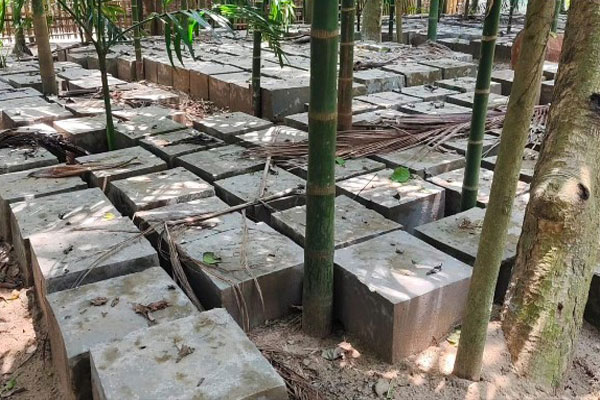
Over 150 low-income families in Sukanta Colony, Ward 16, face catastrophic monsoon displacement after contractors allegedly misappropriated a ₹1-crore Kailashahar flood defense project. Local residents claim massive structural corruption stripped the safety barrier along the turbulent Manu River, leaving families completely exposed to severe bank erosion.
Quick Glance
-
-
The Threat: Rapid erosion along the Manu River endangers 150 economically weaker families in Ward 16 of the Kailashahar Municipal Council.
-
The Project: The Tripura Flood Control Department sanctioned over ₹1 crore to install protective concrete embankment blocks.
-
The Irregularity: Contractors allegedly built shorter blocks, shorted the required quantity by 14,000 units, and used raw river sand.
-
The Demand: Panicked locals have appealed directly to the Tripura Chief Minister for an immediate forensic corruption probe.
-
Marginalized Families Face Seasonal Displacement in Sukanta Colony Ward 16
Kailashahar (Tripura): The annual arrival of the monsoon season fills the residents of Sukanta Colony with deep dread. The community sits directly on the edge of the shifting Manu River. For years, the changing river currents have steadily eaten away at the land beneath this neighborhood.
Unlike affluent urban developments, these low-income earners cannot afford to relocate. Their modest homes represent their entire life savings. They must watch the shoreline creep closer to their doorsteps every day.
Following continuous public appeals, the state government intervened. The Flood Control Department approved an anti-erosion project worth more than ₹1 crore. The plan intended to reinforce the vulnerable riverbank with heavy concrete defense blocks. However, structural compromises have turned a critical lifeline into a source of severe anxiety.
Structural Audits Reveal Major Deviations
Local community members state that corruption marred the public infrastructure project from its inception. Contractors reportedly underbid the official tender to secure the work. They then allegedly used inferior materials and ignored engineering rules to maximize their profit margins.
The physical differences between the official department guidelines and the actual work on the ground reveal a major safety deficit.
| Project Parameter | Official Department Guidelines | Actual On-Ground Execution (Alleged) |
| Block Dimensions | 12-inch height for high hydraulic resistance | Flimsy 8-inch height blocks |
| Total Block Quantity | 18,000 units for continuous defense | Approximately 4,000 units manufactured |
| Material Integrity | Standard cement-to-sand ratio with clean sand | High ratio of unwashed sand taken from the river |
| Installation Method | Structured technical placement by engineers | Randomly dumped into the deep river at night |
Residents note that the contractors completely exhausted the ₹1-crore budget despite the severe deficit in physical work. Local eyewitnesses watched laborers illegally mine unwashed sand straight from the Manu River bed. They mixed this unwashed material with inadequate amounts of cement to cast the safety blocks. Furthermore, workers dropped these substandard blocks into the water at night to conceal the incomplete barrier.
Lack of Oversight and Growing Political Connections
The complete absence of official oversight has worsened public anger. Sukanta Colony residents report that no department engineer visited the site during production. This lack of inspection allowed the contractors to operate without any technical accountability.
Frustrated locals sent multiple formal complaints to senior department supervisors. They also raised the issue with local political leaders. However, authorities took no action to correct the errors.
Local reports suggest the contractors hold significant political influence. These same entities currently manage several major public construction projects across Kailashahar. Shockingly, those other infrastructure works also face similar public complaints regarding structural quality.
A Critical Call for Intervention Before Monsoon
The water levels of the Manu River are already starting to swell. Panic is rising among the families of Ward 16. The community has issued an urgent public plea to the state government and the Chief Minister of Tripura. They want a fast forensic investigation into the allocated funds. They also require the immediate installation of proper, standard-compliant blocks before the floods hit.
Currently, these specific resident complaints remain unverified by an independent body. The Flood Control Department has not released an official statement. However, for the 150 families living on the edge, time is running out. The river is moving closer every single day.
People Also Ask (FAQ)
Where is Sukanta Colony located?
Sukanta Colony is located in Ward No. 16 of the Kailashahar Municipal Council, within the Unakoti District of North East Tripura.
Why are residents protesting the Manu River flood project?
Residents allege massive corruption. Contractors reportedly built only 4,000 of the mandated 18,000 blocks, reduced the block size from 12 inches to 8 inches, and used poor construction materials.
What is the value of the Kailashahar river protection tender?
The state government’s Flood Control Department sanctioned a public project budget worth over ₹1 crore to build the concrete block embankment.
