

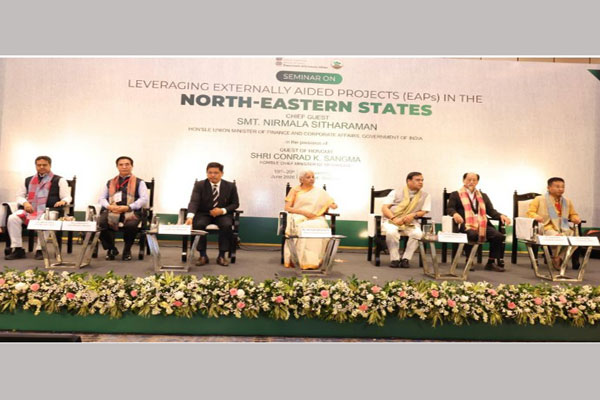
Tripura Chief Minister Prof. Dr. Manik Saha pulled back the curtain on the hidden local costs involved in Externally Aided Projects (EAPs) implementations and urged the Centre to remove the borrowing ceiling on these projects during a Shillong seminar attended by Union Finance Minister Nirmala Sitharaman. He highlighted Tripura’s economic growth, infrastructure needs, and financial challenges in implementing global development projects.
Quick Glance
- Tripura CM Manik Saha demands removal of EAP borrowing restrictions for Northeast states.
- Tripura’s GSDP rises from Rs 55,984 crore in 2019-20 to Rs 1,00,795 crore in 2025-26.
- State highlights hidden costs of land acquisition, forest diversion and utility shifting in EAP projects.
- Eight major externally aided projects are currently underway in Tripura.
Agartala: State Chief Minister Prof. Dr. Manik Saha has called for a policy change in the implementation of EAPs across the Northeast. He urged the Central Government to remove the existing borrowing ceiling on such projects. According to him, the move will help states accelerate infrastructure development and strengthen the vision of the Act East Policy.
Dr. Saha made the remarks while addressing the seminar on “Leveraging Externally Aided Projects (EAPs) in the North Eastern States” in Shillong, Meghalaya. Union Finance Minister Nirmala Sitharaman was present at the event.
The Chief Minister explained that EAPs have played an important role in transforming Tripura’s development landscape. He said international partnerships have supported sectors such as roads, urban development, tourism, healthcare, power and industrial infrastructure.
Tripura’s Growing Role in Externally Aided Projects
Dr. Saha said Tripura has been using assistance from global development agencies for nearly two decades. These agencies include the World Bank, Asian Development Bank (ADB), Indo-German Development Cooperation and Japan International Cooperation Agency (JICA).
He said these collaborations have not only supported physical infrastructure but have also improved institutional capacity and administrative efficiency in the state.
The Chief Minister highlighted the importance of ADB’s North East Economic Corridor Study. He said the study has identified new investment possibilities in multiple sectors across Tripura.
According to him, these opportunities can strengthen industrial growth, improve connectivity and create new employment avenues in the state.
Tripura Economic Growth
Dr. Saha presented key economic indicators to show Tripura’s progress in recent years.
| Indicator | Previous Figure | Current Figure |
|---|---|---|
| Gross State Domestic Product (GSDP) | Rs 55,984 crore (2019-20) | Rs 1,00,795 crore (2025-26) |
| Annual Capital Expenditure | Rs 2,079 crore (2021-22) | Rs 10,478 crore (2025-26) |
The Chief Minister said the sharp rise in capital expenditure reflects the state administration’s improved ability to absorb and utilise development funds.
He added that private investment has also increased significantly. Tripura has signed Memorandums of Understanding worth around Rs 30,000 crore during the past year.
Projects worth more than Rs 8,000 crore have already entered the implementation stage, he said.
Hidden Local Costs Behind EAPs
Dr. Saha raised concerns over the additional financial pressure faced by states while implementing externally funded projects.
He explained that EAPs usually follow an 80:20 Centre-State funding model. However, the actual financial burden becomes much higher because states must manage several preliminary expenses outside the project funding structure.
These expenses include land acquisition, forest land diversion and shifting of utilities.
The Chief Minister said these costs are essential for project execution but often remain outside the main financial support framework.
As a result, the practical financial contribution of states moves closer to a 60:40 ratio, creating additional pressure on state budgets.
He said this situation reduces the overall advantage of externally funded projects and affects states like Tripura that are focusing on infrastructure expansion.
Eight Major EAP Projects Under Implementation in Tripura
Tripura is currently implementing eight major Externally Aided Projects.
These projects cover several priority areas:
- Industrial infrastructure development
- Urban development
- Tourism promotion
- Climate resilience
- Socio-economic advancement of Scheduled Tribes
Dr. Saha said these projects are important for creating long-term economic opportunities and improving living standards in the state.
CM Seeks Flexible Borrowing Policy for Northeast States
The Chief Minister requested the Centre to reconsider the EAP borrowing ceiling introduced from 2023-24.
He suggested that borrowing limits should be based on individual state capabilities. He said administrative efficiency, project execution capacity and fund absorption ability should be considered while deciding limits.
According to Dr. Saha, a flexible approach will allow Northeast states to use development opportunities more effectively.
He said the policy change will support infrastructure creation and economic expansion in the region.
Support for Act East Policy and Future Development
Dr. Saha stated that strengthening EAP implementation is closely linked with the success of the Government of India’s Act East Policy.
He thanked Prime Minister Narendra Modi and Union Finance Minister Nirmala Sitharaman for supporting development initiatives in Tripura.
The Chief Minister also raised concerns regarding the discontinuation of the Revenue Gap Grant after the recommendations of the 16th Finance Commission.
While appreciating support under the “Pride of Hills” initiative, he requested higher allocations to meet committed expenditure needs.
He reaffirmed Tripura’s commitment to expanding industrial development, road connectivity, skill development, renewable energy, tourism and other priority sectors.
