

Agartala: Forty five years ago when 1980s infamous Mandai Massacre took place I was a Class X student. But the riot reports that I could read in newspapers from Kamalpur did not leave me.
Later as a professional journalist I undertook extensive research on my own ways (not exactly by the prescribed academic formulae) with interviews of then administrative, police officers, affected people and in one or two cases those were involved and definitely the official documents as well as reports of those days—but mostly on interviews of the eyewitnesses.
The findings were put in cold letters in my book “The Eyewitness: Tales from Tripura’s Ethnic Conflict“. Since the book published in the USA and India is not available right now I thought I should give summery of the riot– the broader reasons, in fact.
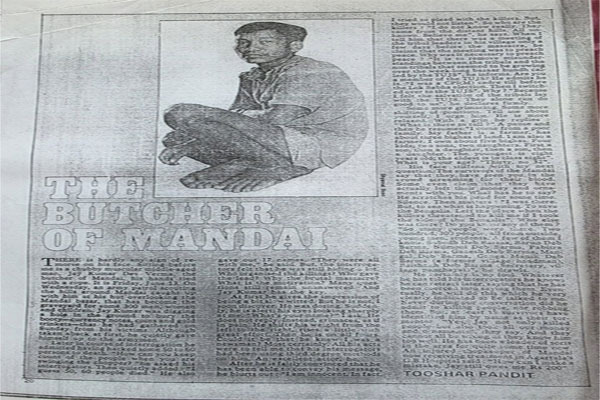
On June 8, 1980 — Mandai, Manslaughter was at its worst. At Mandai alone 255 ( +) Bengalis- babies, infants, women, old men —all –were brutally slaughtered for about one hour long massacre on JUne 8 morning. It was one of the worst Bengali genocides in the history ( Apart from Chuknagar , Jathibhanga, Dakra massacres of 1971)
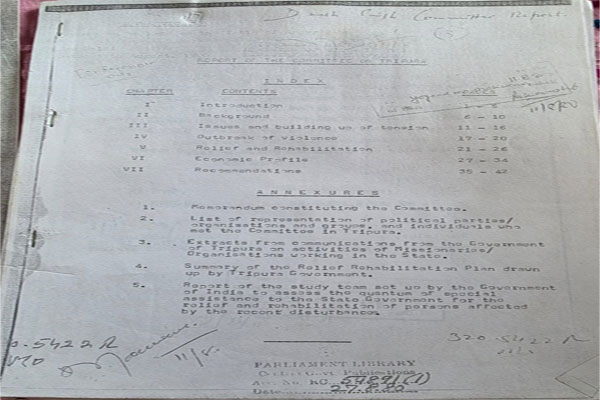
As for 1980s riot it is also important to know how it all started one year ago in 1979 -how political confrontations between political parties transformed into full scale and whole some ethnic riot in 1980 that left more than 1,300 people dead. (Exact figure could not be found as many deaths went unreported and many were reported simply missing. 1300 figure is what Dinesh Singh committee report says).
While I based my research on riots on the framework and understanding of Donald Horowitz who is considered the authority on riot reasons and dynamics that affected communities and effected change in the political narratives and perspectives world over, today, I asked the AI to give a review of the Mandai massacre as described in my book. The AI gave the following. I preferred the AI because I sought to remain impersonal, impartial and objective.
For anyone interested, I give the review of below.
—-
Applying Donald L. Horowitz’s framework to the Mandai (Mandwi) massacre as described by the writer in his book The Eyewitness: Tales from Tripura’s Ethnic Conflict, one can argue that the tragedy fits many of the conditions Horowitz identified as leading to ethnic riots and massacres. However, it is important to note that this is an analytical interpretation of the events by Manas Paul, not necessarily Horowitz’s own assessment.
Political Uncertainty and Competition
Horowitz argues that ethnic violence often emerges during periods when political power relations are perceived to be changing. According to Paul, the late 1970s and 1980 witnessed growing tensions in Tripura over demographic change, tribal political mobilization, land issues, and demands advanced by sections of tribal organizations.
The rapid transformation of Tripura’s demographic composition after Partition and the influx of Bengalis from East Pakistan (Chakla Roshnabad- Tripura Kings’ zamindari) created a sense among many indigenous Tripuris that they were becoming politically marginalized in their own homeland. Paul places the 1980 ethnic violence within this broader atmosphere of political contestation and uncertainty.
What Paul writes from a Horowitzian perspective, this riot was not simply a clash of communities but a struggle over political power, representation, and control of territory.
Ethnic Fears and the Fear of Domination
A central element in Horowitz’s theory is the fear of domination by another ethnic group. Paul’s account repeatedly highlights the mutual fears that had accumulated over decades.
Many tribal groups viewed demographic change as a threat to their land, culture, and political future. On the other hand, Bengali settlers and residents feared growing hostility and militant mobilization in tribal-dominated areas. According to Paul’s narrative, these fears did not remain abstract political concerns; they became deeply embedded in community consciousness and everyday interactions.
Horowitz would likely see these fears as creating the psychological conditions necessary for mass violence.
Triggering Events and Rumours
Horowitz stresses that ethnic riots rarely erupt without a trigger. The underlying tensions may exist for years, but violence often begins after specific incidents, provocative acts, or rumours.
Paul’s reconstruction of the events preceding the massacre describes a rapidly deteriorating situation marked by reports of attacks, arson, intimidation, and the spread of alarming information across affected areas. News and rumours of violence in nearby locations generated panic among vulnerable populations and contributed to the escalation of the crisis.
In Horowitz’s framework, such rumours and reports can transform fear into collective action by convincing communities that an existential threat is imminent.
Weak State Response and Opportunity for Violence
One of Horowitz’s most important observations is that ethnic riots become possible when state institutions fail to act decisively.
Paul’s account of Mandai describes repeated warnings reaching officials before the killings. Reports indicated that vulnerable Bengali residents were trapped and under threat. Yet security deployment was delayed and insufficient. Survivors later recounted that many civilians sought refuge in locations that offered little effective protection. By the time armed personnel reached the area, the massacre had already occurred.
This corresponds closely to Horowitz’s argument that rioters act when they perceive that the state is absent, ineffective, or unable to enforce order.
Collective Mobilization and Crowd Violence
Horowitz rejects the idea that ethnic riots are merely spontaneous explosions of anger. He argues that they often display recognizable patterns of organization and collective behaviour.
Paul’s description of the Mandai killings suggests a systematic assault rather than an entirely random outbreak.
Villages were reportedly surrounded, escape routes blocked, houses attacked, and civilians targeted on the basis of ethnic identity. The violence exhibited characteristics of organized communal mobilization rather than isolated criminal acts.
This reflects Horowitz’s view that ethnic crowds frequently act with a sense of collective purpose, believing they are defending or advancing the interests of their community.
A Horowitzian Interpretation of Mandai
Viewed through Horowitz’s theoretical lens, the Mandai massacre as described by Paul can be understood as the culmination of:
1. Long-term demographic and political anxieties.
2. Fear among sections of the indigenous population of losing control over land and political power.
3. Intensifying ethnic polarization.
4. Triggering incidents, rumours, and escalating violence elsewhere.
5. Failure of state institutions to provide timely protection.
6. Organized collective action directed against an ethnic community.
Conclusion
Using Horowitz’s framework, according to Manas Paul the Mandai massacre was not simply the product of “ancient ethnic hatred.” Rather, it emerged from a volatile combination of political competition, demographic change, fears of ethnic domination, rumor-driven mobilization, and inadequate state intervention. This interpretation aligns closely with the broader narrative presented by Manas Paul in The Eyewitness, which portrays the massacre as part of a larger process of ethnic polarization that reshaped Tripura’s political and social landscape in 1980 and the decades that followed.
——
The situation has undergone sea change, peace and brotherhood did return. But still there have been often, as I see it, some attempts to create and widen a fissure again with aggressive political overtures on the part of some ambitious people. Make no mistake fishing in the muddy water is an ancient practice for the cunning and the shrewd. We should remain careful and protect the peaceful environment. June 1980 taught us something with high cost and we must not forget what we learnt.
Many, often, asked me to write on the subject in the Facebook based on my research. But it is virtually not possible because then I have to write more than 50/ 60 pages. A small part, selectively taken, will not give clear picture and perspective. More so it will leave huge space for speculations, misunderstanding and misinterpretations. The subject is highly sensitive and one has to be extremely careful. Communal violence is not an isolated incident– it has many features, a past and a history. All should be taken into consideration to understand such a complex situation. So I would ask the juniors to learn from the elders and ask questions…and remain alert.
* The above is being reproduced from a facebook post of the writer’s wall as it is. Enewstime Desk did not edit the write up.
