

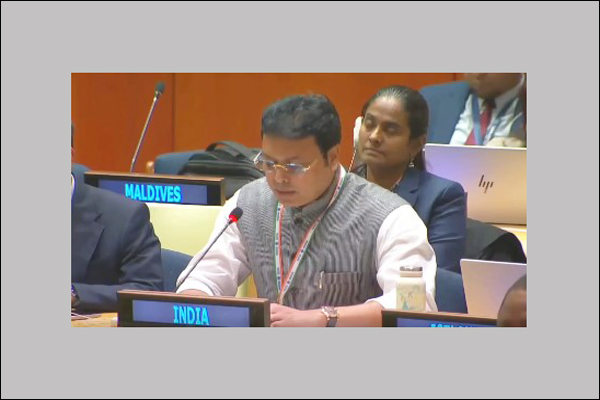
Tripura West MP Biplab Kumar Deb urged stronger global action against terrorism at the 81st UNGA Sixth Committee session, stressing zero tolerance, action against terror financing and safe havens, emerging technology misuse and accountability while highlighting India’s position on the Pahalgam attack.
Quick Glance
- Biplab Kumar Deb delivered India’s National Statement at the UNGA Sixth Committee.
- He called for zero tolerance against terrorism in all forms, including cross-border terrorism.
- India urged stronger action against terror financing, safe havens and technology misuse.
- Deb also responded to the OIC statement on Pakistan and Pakistan-occupied Jammu and Kashmir.
India reiterates zero-tolerance approach
Tripura West MP Biplab Kumar Deb delivered India’s National Statement during the 81st Session of the United Nations General Assembly (UNGA), Sixth Committee.
The discussion focused on “Measures to Eliminate International Terrorism”.
Deb said India remains committed to a firm zero-tolerance approach to terrorism under the leadership of Prime Minister Narendra Modi.
He called for decisive international action against terrorist networks. He also stressed the need to target terror financing and those who provide safe havens to terrorists.
According to Deb, terrorism remains one of the most serious threats to humanity. Its impact extends beyond security concerns.
He said terrorism threatens international peace and security, economic progress, democratic systems and human rights.
Deb also congratulated the Chair and members of the Bureau on their election. He thanked the UN Secretary-General for his report.
No distinction between good and bad terrorism
Deb said terrorism directly attacks the fundamental right to life.
He described terrorism as contrary to the values of the United Nations. He also stressed that deliberate attacks on civilians cannot receive any justification.
“There is no distinction between good and bad terrorism,” Deb said.
India, he added, views terrorist acts as crimes against humanity.
Deb cited Prime Minister Narendra Modi’s position that even one terrorist attack is too many and every single life lost to terrorism is one life too many.
Terror groups exploiting emerging technologies
Deb raised concerns over the growing misuse of emerging technologies by terrorist organisations.
He said terrorist groups are using new technologies for recruitment, radicalisation, propaganda, operational planning and financing.
Their anonymity and global reach can make it harder for law enforcement agencies to track them, he said.
Terrorist organisations can also use these capabilities to target vulnerable young people.
Deb called for stronger international cooperation to modernise counter-terrorism efforts.
He also highlighted the continuing absence of the Comprehensive Convention on International Terrorism (CCIT).
India circulated its draft in 1996. Deb said the early conclusion of the CCIT would strengthen the international legal framework for combating terrorism comprehensively.
He also referred to paragraph 3 of UN Security Council Resolution 1566. According to Deb, the provision offers an important basis for further discussions on serious violence against civilians and other specified acts.
Pahalgam attack cited as a warning
Deb said India’s experience shows that terrorism is not a hypothetical threat.
He described it as a continuing and daily reality.
“For decades, our people have suffered from cross-border terrorist violence,” he said.
Deb highlighted the April 2025 terrorist attack in Pahalgam. He said the attack demonstrated once again the severe human cost of terrorism.
He described the attack as a deliberate assault on India’s sovereignty.
Deb said networks behind the attack continue to receive protection, sanctuary and material support from a country across India’s western border.
He also cited the New Delhi Declaration adopted at the BRICS Summit on September 12, 2026.
Deb said the declaration strongly condemned the Pahalgam attack. It also rejected all acts of terrorism, regardless of their purpose, location, timing or perpetrators.
India lists six counter-terrorism priorities
Deb outlined six priorities for India’s counter-terrorism efforts.
| Priority | India’s stated focus |
|---|---|
| 1 | End double standards and ensure accountability |
| 2 | Disrupt terror financing through stronger financial intelligence and FATF implementation |
| 3 | Address the misuse of emerging technologies |
| 4 | Keep victims of terrorism at the centre of efforts |
| 5 | Strengthen nationally owned capacity building for the Global South |
| 6 | Counter terrorist ideologies and address conditions conducive to terrorism |
Deb said the international community must move beyond reviewing policies. It must also focus on implementation.
He added that the Global Counter-Terrorism Strategy (GCTS) should remain focused on its core objectives.
India highlights global counter-terrorism initiatives
Deb pointed to India’s role in international counter-terrorism initiatives.
He said India hosted the “No Money for Terror” conference and the Interpol General Assembly in 2022.
India also continues to participate actively in Financial Action Task Force (FATF) proceedings and deliberations, he said.
Delivered India’s National Statement at the 81st Session of the United Nations General Assembly (#UNGA), Sixth Committee, on the agenda item “Measures to Eliminate International Terrorism.”
Under the visionary leadership of Hon’ble Prime Minister Shri @NarendraModi Ji, India continues to champion a firm zero-tolerance approach to terrorism and call for decisive global action against terror networks, their financing and those who provide them safe havens. India’s resolve reflects PM Modi Ji’s commitment to a secure, peaceful and rule-based world order.
— Biplab Kumar Deb (@BjpBiplab) October 7, 2026
Deb said India has supported capacity building and consistently advocated stronger multilateral action.
He also referred to India’s national counter-terrorism policy and strategy, “Prahar”, launched earlier this year.
The initiative seeks to strengthen India’s national mechanisms for preventing and responding to terrorist attacks. It also promotes a whole-of-society approach and greater international cooperation.
Deb responds to OIC statement
Deb then responded to the statement by the Chair of the Organisation of Islamic Cooperation (OIC).
The OIC statement had referred to India’s measures against terrorist infrastructure in Pakistan and Pakistan-occupied Jammu and Kashmir.
Deb said terrorist attacks against India have been planned and directed from these networks.
He criticised the OIC statement for failing, in his view, to distinguish between facts and fiction and between victims and perpetrators.
“India has every right to protect its people against cross-border terrorism emanating from Pakistan,” Deb said.
He added that those involved in terrorism must face consequences.
Jammu and Kashmir reference draws sharp response
Deb also rejected what he described as an inappropriate OIC reference to the Union Territory of Jammu and Kashmir.
He said the OIC Chair should instead focus on Pakistan’s illegal occupation.
He specifically referred to Rawalakot. Deb alleged that brutal violence and denial of basic rights were visible there.
He said deliberately ignoring such issues reflected what he termed “bigotry and hypocrisy”.
Deb concluded by urging UN member states to work collectively against terrorism.
He called for a stronger and more effective international process to counter the global threat.
People Also Ask
What is India’s position on the CCIT?
India supports the early conclusion of the Comprehensive Convention on International Terrorism, saying it would strengthen the international legal framework against terrorism.
What did Biplab Deb say about cross-border terrorism?
Deb said India has suffered from cross-border terrorist violence for decades and called for stronger international action against terrorist networks and their supporters.
What counter-terrorism strategy did India highlight? India highlighted its national counter-terrorism policy and strategy named “Prahar” alongside six core global priorities.
