

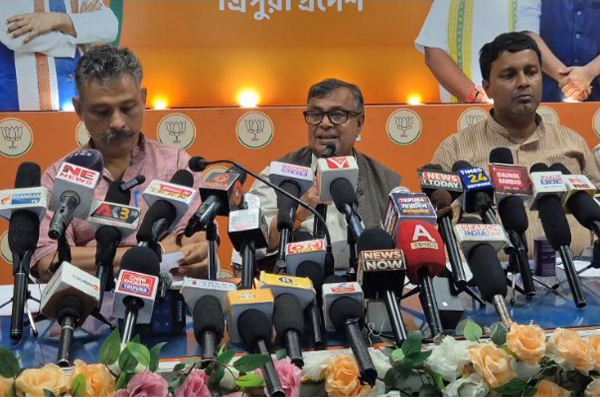
Tripura Minister and senior BJP leader Ratan Lal Nath underscored the ‘weak organization’ of the Opposition, especially the CPIM and the lack of its presence at ground zero during the Civic Body elections poll campaign and on polling day. He criticised the CPIM and Congress for their alleged failure to maintain grassroots organisational networks, questioning their absence from public rallies, street-corner meetings and door-to-door campaigns in the run-up to the November 27 municipal elections and accusing them of relying increasingly on hired social media services.
At A Glance
-
Ratan Lal Nath questioned the CPIM’s organisational strength and its ability to mobilise people during the Tripura ULB election campaign.
-
The minister alleged that Opposition parties had become dependent on hired social media services instead of strengthening their grassroots networks.
-
He challenged Opposition leaders to explain their absence from public demonstrations, rallies and protests despite allegations of intimidation.
Tripura Minister Ratan Lal Nath on Friday launched a sharp attack on the CPIM and Congress, questioning their organisational capabilities and alleged failure to connect with voters during the Urban Local Body (ULB) election campaign. He claimed that the Opposition parties had lost their grassroots presence and increasingly depended on hired social media services to remain politically relevant.
Addressing a press conference in Agartala after polling concluded on November 27, Nath questioned whether the CPIM and Congress had organised any significant public meetings, rallies, processions or street-corner meetings during the election campaign.
He argued that the absence of such activities reflected the weakening organisational structures of the Opposition parties. The minister particularly questioned the CPIM’s ability to mobilise supporters and maintain an active presence among people.
Nath questions CPIM’s grassroots organisational strength
Nath claimed that the organisational strength of the CPIM had declined considerably. He challenged the party’s leadership to explain how it could sustain itself without an active network of workers and supporters at the grassroots level.
Referring to the campaign activities ahead of the civic elections, he asked whether the CPIM or Congress had organised any major rallies or public gatherings.
The minister also questioned their participation in street-corner meetings, processions and door-to-door campaigns. According to him, these activities form the foundation of political mobilisation and help parties maintain direct contact with voters.
Nath further questioned whether the Opposition parties had active student, youth and women’s leadership capable of strengthening their organisational presence.
He argued that political parties needed functioning grassroots structures to sustain themselves and remain connected with the electorate. He suggested that the Opposition’s alleged failure to maintain these networks had weakened its ability to organise political activities.
Accuses Opposition of depending on hired social media services
The minister alleged that the CPIM and other Opposition parties had increasingly shifted their focus towards social media instead of rebuilding their organisational structures.
He claimed that they were depending on hired social media services to carry out political campaigns and communicate their allegations against the ruling party.
Nath maintained that social media activity alone could not replace an active political organisation. He argued that parties could not sustain themselves merely by making allegations against the government or maintaining an online presence.
According to him, political organisations needed to engage directly with people, organise public programmes and demonstrate their strength through activities at the grassroots level.
His criticism centred on what he described as a growing gap between the Opposition’s online political activities and its presence on the ground.
Challenges Opposition to lead public protests
Nath also questioned why Opposition leaders were not organising public demonstrations if their workers and supporters were facing intimidation.
He urged the media to ask Opposition leaders why they were not leading processions from their respective party offices or staging protests outside police stations.
The minister argued that parties claiming their workers faced threats or intimidation should demonstrate their organisational strength through public protests and other political programmes.
He suggested that such activities would allow the Opposition to establish its presence among people rather than relying primarily on allegations and social media campaigns.
Nath contrasts current polling with previous Left Front elections
During the press conference, Nath also defended the conduct of Friday’s ULB elections, describing the polling atmosphere as peaceful and festive.
To support his assessment, he displayed video clips and newspaper reports relating to elections held during the previous CPIM-led Left Front government. The archival material included reports carrying allegations of booth capturing, ballot theft and election-related violence.
He presented the footage and reports to draw a contrast between the previous election experience and the current polling process.
The minister also played video interviews with voters who described their polling experience as peaceful and trouble-free. Among them was a woman whom Nath identified as the wife of CPIM candidate Dulal Ghosh. She said she had cast her vote without facing any difficulty.
Nath maintained that voters had been able to exercise their franchise without obstruction. He also thanked the State Election Commission, administration, police personnel and voters for their participation in the electoral process.
Says strong Opposition is essential for democracy
Despite his criticism of the rival parties, Nath acknowledged that a strong Opposition was necessary for a functioning democracy.
However, he maintained that the CPIM and Congress needed to rebuild their organisational structures and establish a stronger connection with voters.
He expressed confidence in the BJP’s electoral prospects, predicting that his party would win all 51 wards of the Agartala Municipal Corporation.
Nath also rejected the Opposition’s description of the ULB elections as a semi-final ahead of the next Assembly election. He said the BJP treated every election seriously, including contests at the local level.
