

The DRI’s seizure of codeine-based cough syrup worth Rs 6.54 crore at Agartala Railway Station has renewed focus on the growing use of goods trains for drug trafficking in Tripura. The latest case, following another major railway haul in 2025, highlights evolving smuggling tactics, intelligence-led enforcement, and the increasing need for tighter monitoring of railway freight corridors.
Narco Smuggling: Why Goods Trains Are Emerging as a Major Route for Codeine Cough Syrup Trafficking In Tripura
Agartala: The Directorate of Revenue Intelligence (DRI)’s latest seizure of prohibited codeine-based cough syrup worth Rs 6.54 crore at Agartala Railway Station has once again drawn attention to a growing concern for law enforcement agencies—the increasing use of railway cargo services for transporting narcotics and controlled pharmaceutical products into and through Tripura.
Although the operation resulted in the recovery of more than 55,000 bottles of codeine-based cough syrup and the arrest of one suspect, investigators believe the case is part of a much larger pattern involving organised trafficking networks that are exploiting India’s expanding railway logistics system.
The latest case is not an isolated incident. It is the second major recovery of banned cough syrup from a goods train in Tripura within a year, suggesting that traffickers continue to view rail transport as an effective means of moving illegal consignments across states.
Security agencies say goods trains offer several advantages to organised smuggling networks.
Unlike passenger baggage, commercial freight often carries thousands of packages belonging to multiple consignors and consignees. This large volume makes it easier for traffickers to conceal illegal consignments among legitimate cargo.
High Capacity Parcel Vans attached to freight trains can transport substantial quantities of goods over long distances at comparatively lower costs. Such shipments also pass through multiple railway stations before reaching their destination, making detection more challenging without specific intelligence inputs.
In the latest seizure, officials said the consignment had originated from Katihar in Bihar before being transported to Agartala through a parcel van attached to a goods train.
Investigators suspect that carefully planned logistics and documentation are increasingly being used by trafficking syndicates to move prohibited pharmaceutical products across state borders.
Codeine cough syrup remains a preferred contraband
The recovered Eskuf Cough Syrup and Fairdyl Cough Syrup contain Codeine Phosphate along with Triprolidine Hydrochloride.
While these medicines are legally manufactured for therapeutic purposes under regulated conditions, law enforcement agencies have repeatedly found that they are diverted into illegal markets where they are consumed for their narcotic effects.
Officials say such cough syrups continue to attract traffickers because they can generate significant profits when diverted from legitimate medical supply chains.
The demand extends beyond India’s borders, with enforcement agencies in the Northeast frequently linking seizures to illegal cross-border trafficking networks operating towards neighbouring Bangladesh.
Recent seizures indicate a continuing trend
The latest recovery follows another major operation conducted in October 2025, when the Tripura Police Crime Branch, with support from other security agencies, seized banned cough syrup valued at nearly Rs 5.4 crore from a goods train at Jirania Railway Station.
That consignment had reportedly travelled from Delhi along with commercial goods including rice and poultry feed.
Investigators subsequently arrested several accused persons, including an alleged kingpin believed to have links with a wider drug trafficking network operating across multiple northeastern states.
Taken together, the two large recoveries suggest that railway freight services remain under constant watch by enforcement agencies as organised smugglers continue to explore new methods of transporting contraband.
Intelligence-led operations proving effective
Officials attribute the success of recent crackdowns largely to intelligence-based surveillance rather than routine inspections.
The DRI’s latest operation was reportedly launched following specific intelligence inputs and was conducted jointly with personnel from the Assam Rifles, the Railway Protection Force (RPF) and other security agencies.
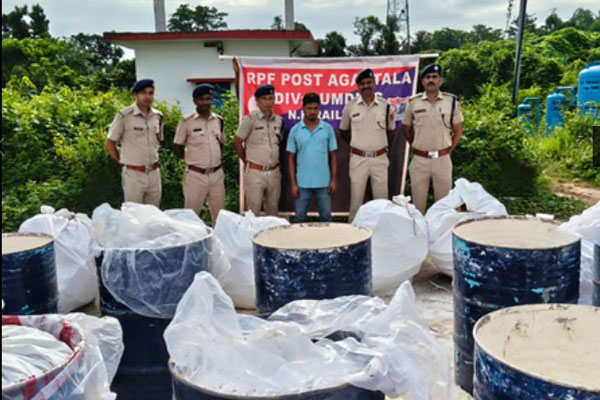
Such coordinated operations have become increasingly important because illegal consignments are often disguised as legitimate commercial cargo.
Investigators believe stronger intelligence sharing among central and state agencies has significantly improved interception rates over the past few years.
Investigation shifts beyond the seizure
The recovery of the cough syrup marks only the beginning of the investigation.
Officials have registered a case under the Narcotic Drugs and Psychotropic Substances (NDPS) Act, 1985, and are now examining the complete supply chain behind the consignment.
The investigation is expected to focus on identifying:
- The original supplier of the prohibited medicines.
- Individuals responsible for booking the consignment.
- The intended recipients in Tripura or elsewhere.
- Financial transactions connected with the shipment.
- Possible interstate and cross-border links.
Investigators may also analyse digital communication records, transport documents and banking transactions to establish whether the seizure is connected to a larger organised network.
Railway security remains under focus
The repeated recovery of narcotics and codeine-based pharmaceutical products from railway cargo has prompted security agencies to strengthen monitoring of freight operations.
Apart from banned cough syrup, authorities have previously intercepted consignments of cannabis and other illegal substances being transported through rail routes linking Tripura with different parts of the country.
Officials believe that enhanced surveillance, better cargo profiling and intelligence-driven inspections will remain essential as traffickers continue to adapt their methods.
| Tripura Related News: Tripura NH-8 Four-Lane Project Enters Land Acquisition Phase |
With railway connectivity expanding across the Northeast, enforcement agencies are expected to maintain close coordination to prevent organised criminal networks from exploiting freight transport systems.
Why this case matters: Enewstime Desk’s Perspective
The Rs 6.54 crore seizure is significant not merely because of its monetary value but because it reinforces a broader enforcement challenge facing agencies in the Northeast. Repeated recoveries from goods trains indicate that traffickers continue to experiment with commercial logistics channels to move controlled substances over long distances.
| Related News: Tripura Drug Trafficking Crisis: DYFI Flags Growing Narcotics Network, Seeks Police Action |
For investigators, the success of intelligence-led operations demonstrates the importance of inter-agency coordination. At the same time, the case highlights the need for sustained vigilance over railway freight movement, stronger monitoring of pharmaceutical supply chains and continued efforts to dismantle the organised networks that facilitate such trafficking.
As the DRI expands its investigation, officials hope the evidence collected from the latest seizure will help expose the larger syndicate behind the consignment and disrupt similar smuggling attempts in the future.
