

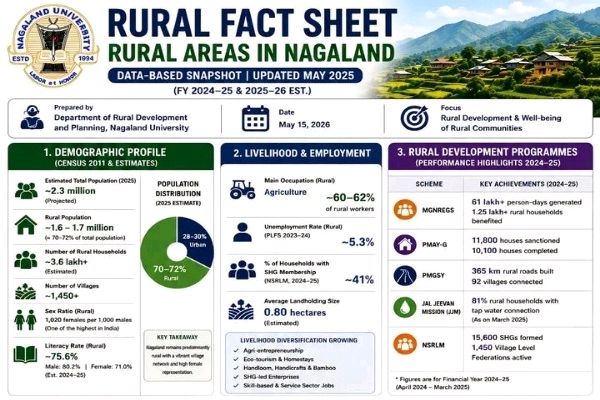
Nagaland University has released a detailed Rural Development Fact Sheet 2025 highlighting the socio-economic condition of rural Nagaland for 2024-25 and 2025-26.
Released recently, the report showcases progress in rural infrastructure, agriculture, sanitation, and livelihood generation while identifying key challenges like jhum cultivation dependency and youth migration.
Quick Glance
- Rural population in Nagaland remains dominant at nearly 70-72% of the State’s population.
- Around 61 lakh person-days were generated under MGNREGS during 2024-25.
- Rural electrification reached 98%, while tap water connectivity touched 81%.
- Organic farming, eco-tourism, and bamboo enterprises emerged as future growth opportunities.
Nagaland University Releases Rural Development Snapshot for 2025
Agartala: Nagaland University released a comprehensive assessment of rural Nagaland through the latest “Rural Development Fact Sheet”. The Department of Rural Development and Planning prepared the report. It provides updated data on rural demographics, employment, agriculture, infrastructure, and welfare schemes across the State.
The fact sheet covers the financial years 2024-25 and 2025-26. The document focuses on improving the well-being of rural communities while also evaluating the impact of ongoing development programmes.
The report highlights achievements in rural electrification, road connectivity, sanitation, housing, and livelihood support. However, thr report underlined concerns over climate vulnerability, youth migration, and heavy dependence on jhum cultivation.
Rural Population Still Dominates Nagaland
The report stated that Nagaland’s estimated population in 2025 stands at around 2.3 million. Among them, nearly 1.6 to 1.7 million people continue to live in rural areas.
An estimated 3.6 lakh rural households are spread across nearly 1,450 villages in the State. Rural residents account for nearly 70-72 percent of the total population. Urban areas account for only 28-30 percent.
The literacy rate in rural Nagaland was estimated at 75.6 percent. Male literacy stood at 80.2 percent, while female literacy was recorded at 71 percent.
The report observed that village-based social systems remain strong in Nagaland. Community participation and women’s involvement in rural activities were described as major strengths.
Agriculture Continues to Support Rural Economy
Agriculture was identified as the principal source of livelihood in rural Nagaland. Around 60-62 percent of rural workers remain dependent on farming and allied sectors.
The average landholding size in rural regions was estimated at 0.80 hectares. Meanwhile, the unemployment rate in rural areas stood at around 5.3 percent, according to PLFS 2023-24 data.
The report further noted that around 41 percent of rural households are linked with Self Help Groups (SHGs) under the National Rural Livelihood Mission framework.
Alternative income opportunities are also gradually increasing. Eco-tourism, handicrafts, bamboo enterprises, and small service-sector jobs are gaining momentum in rural districts.
Key Rural Development Indicators in Nagaland
| Sector | Achievement/Status |
|---|---|
| Rural Population | 1.6-1.7 million |
| Rural Households | 3.6 lakh |
| Villages | Nearly 1,450 |
| Rural Electrification | 98% |
| Tap Water Coverage | 81% |
| Sanitation Coverage | 95% |
| MGNREGS Person-Days Generated | 61 lakh |
| PMAY-G Houses Sanctioned | 11,800 |
| PMAY-G Houses Completed | 10,100+ |
| Rural Roads Built under PMGSY | 365 km |
| Villages Connected by Roads | 92 |
| Functional CSCs | 1,125 |
| Forest Cover | 76% |
| Farmers Under Organic Farming | 13,500 |
Welfare Schemes Deliver Significant Outcomes
According to the fact sheet, several flagship schemes achieved notable progress during 2024-25.
Under MGNREGS, nearly 61 lakh person-days of employment were generated. Around 1.25 lakh rural households benefited from the programme.
The Pradhan Mantri Awas Yojana-Gramin (PMAY-G) sanctioned nearly 11,800 houses. More than 10,100 houses were reportedly completed.
Road connectivity also improved considerably. Around 365 km of rural roads were constructed under the Pradhan Mantri Gram Sadak Yojana (PMGSY). As a result, 92 villages received better road access.
The Jal Jeevan Mission also recorded substantial progress. Tap water connections reached nearly 81 percent of rural households by March 2025.
Additionally, nearly 15,600 Self Help Groups were formed under the National Rural Livelihoods Mission (NRLM). Around 1,450 Village Level Federations became operational across Nagaland.
Rural Infrastructure and Digital Access Improve
The report indicated that rural infrastructure has steadily improved over recent years.
Rural electrification reached 98 percent at the household level. Sanitation coverage climbed to 95 percent across rural areas.
Digital access has also expanded. Around 1,125 Common Service Centres (CSCs) are now functional in rural regions. These centres are helping villagers access online services and government schemes.
The report stated that nearly 78 percent of villages now enjoy all-weather road connectivity. Improved infrastructure was described as a key factor driving inclusion and productivity in rural communities.
Organic Farming and Forest Wealth Highlighted
Nagaland’s biodiversity and natural resources continue to support rural livelihoods.
The report stated that around 13,500 farmers are now covered under organic farming initiatives through the MOVCDNER programme.
Major crops grown in the State include rice, millet, ginger, orange, turmeric, potato, pineapple, and kiwi.
Jhum cultivation continues across nearly 1.3 to 1.4 lakh hectares during 2024-25. Meanwhile, forest cover in rural Nagaland remains high at around 76 percent of the geographical area.
Traditional knowledge systems and eco-friendly farming methods were identified as major strengths of the rural economy.
Challenges and Opportunities Identified
Despite notable development gains, several structural challenges remain.
Dependence on jhum cultivation continues to affect agricultural sustainability. Youth migration from villages is also increasing. Inadequate market access for rural products remains another major concern.
The report also warned about climate-related vulnerabilities affecting agriculture and rural livelihoods.
However, several growth opportunities were identified. These include eco-tourism, bamboo value chains, organic farming, digital agriculture, and green enterprises.
Skill development programmes under NSDC, PMKVY, and RSETI were also highlighted as important tools for strengthening rural employment.
Sustainable Development Goals Remain Central
The Rural Fact Sheet aligned Nagaland’s development efforts with the Sustainable Development Goals (SDGs). The focus areas include poverty reduction, clean drinking water, sanitation, gender equality, climate action, and decent employment.
The report was prepared using data from Census 2011, NFHS-5, Forest Survey of India reports, Jal Jeevan Mission records, Economic Survey documents, and Rural Development Department inputs.
The concluding section stressed that sustainable growth in Nagaland would require diversification of livelihoods, stronger infrastructure, better skills, and climate-resilient development planning.
People Also Ask (FAQs)
What is the Nagaland Rural Fact Sheet 2025?
The Nagaland Rural Fact Sheet 2025 is a data-driven report prepared by Nagaland University highlighting rural demographics, infrastructure, agriculture, and development indicators in the State.
What percentage of Nagaland’s population lives in rural areas?
According to the report, nearly 70-72 percent of Nagaland’s population continues to reside in rural areas.
Which schemes showed major progress in rural Nagaland?
Schemes like MGNREGS, PMAY-G, PMGSY, Jal Jeevan Mission, and NRLM recorded significant achievements during 2024-25.
