

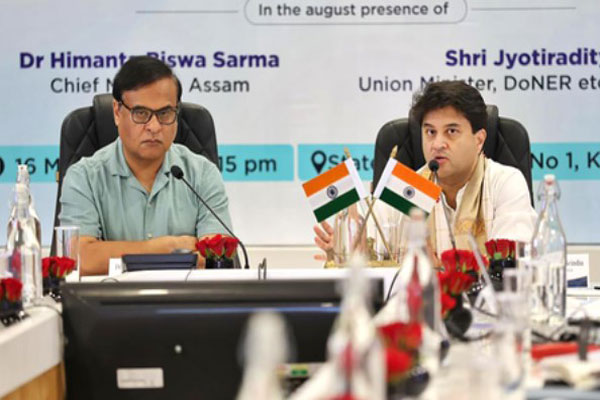
Northeast India is witnessing a major green growth push as the Centre combines infrastructure growth with environmental protection and community welfare. Through MDoNER schemes, PM-DevINE projects and improved connectivity, the region is emerging as a sustainable gateway linking India with Southeast Asia.
Quick Glance
- MDoNER sanctioned 3,746 projects across eight northeastern states, with 2,730 completed projects worth over Rs 27,963 crore.
- PM-DevINE is supporting 48 high-impact projects with an allocation of Rs 6,600 crore.
- Northeast India is adopting eco-friendly transport solutions such as aerial ropeways in difficult terrains.
- Highway and railway expansion is strengthening regional connectivity and economic opportunities.
New Delhi: Northeast India is entering a new chapter of development where modern infrastructure growth is moving together with ecological protection and cultural preservation. The region is no longer following only traditional construction methods. Instead, the focus has shifted towards sustainable projects that support connectivity, economic growth and local communities.
The eight northeastern states are experiencing rapid transformation due to focused government policies and long-term investment. Improved roads, railway networks, energy projects and public services are helping the region become more connected with the rest of India.
At the same time, the development approach aims to protect the region’s forests, mountains and unique cultural heritage.
MDoNER Drives Large-Scale Development Across Northeast States
The Ministry of Development of North Eastern Region (MDoNER) has become a key institution behind the region’s development journey. Through different Central Sector Schemes, the ministry has supported infrastructure and social development projects across the Northeast.
According to official data, thousands of projects have received approval over the years. A large number of them have already reached completion, creating visible changes in transport, services and local infrastructure.
| Development Indicator | Status |
|---|---|
| Total sanctioned projects | 3,746 |
| Completed projects | 2,730 |
| Approved investment | More than Rs 27,963 crore |
| Covered region | Eight Northeast states |
The investment pattern shows a clear focus on improving basic facilities while also creating long-term economic opportunities.
PM-DevINE Pushes Sustainable Infrastructure Projects
The Prime Minister’s Development Initiative for North East Region has emerged as one of the major programmes supporting high-impact development in the region.
The scheme received a total allocation of Rs 6,600 crore for the period between 2022-23 and 2025-26. It supports projects linked with infrastructure, livelihood creation, social development and critical regional needs.
Currently, 48 projects are being implemented under PM-DevINE. These projects represent a new model where development focuses on both economic benefits and environmental responsibility.
Eco-Friendly Connectivity Gains Importance in Mountain Areas
The Northeast has a difficult geographical landscape. Many areas have steep hills, dense forests and sensitive ecosystems. Because of this, authorities are exploring alternative transport systems that reduce environmental pressure.
Aerial ropeways are becoming an important part of this strategy. These systems provide mobility in challenging areas without requiring extensive road cutting and large-scale land clearance.
In Sikkim, projects such as the Dhapper to Bhaleydhunga Cable Car are examples of this approach. The project aims to improve passenger movement across mountainous terrain while reducing dependence on conventional hill road expansion.
Another important initiative is the Pelling to Sanga-Choeling Tramway project. It focuses on connecting tourism and cultural locations through an environmentally sensitive transport system.
These projects can strengthen tourism while protecting the natural character of the region.
Infrastructure Expansion Strengthens Northeast Connectivity
Connectivity remains a major factor behind the region’s transformation. Better transport links are improving movement between remote areas and major economic centres.
The National Highways network has expanded significantly in recent years.
| Sector | Earlier Status | Current Progress |
| National Highways network | 10,905 km in 2014 | 16,207 km as of April 1, 2025 |
| Railway track commissioning | 333 km during 2009-14 | More than 1,900 km during 2014-26 |
Road and rail expansion is improving access to markets, education, healthcare and tourism destinations.
Act East Policy Places Northeast at Strategic Centre
The Act East Policy has increased the importance of the Northeast in India’s regional strategy.
The policy focuses on better connectivity, trade relations, cultural cooperation and border infrastructure with Southeast Asian countries.
The region is gradually developing into a major link between India and neighbouring international markets.
The concept of “Ashtalakshmi” reflects the importance of the eight northeastern states. The region is becoming more connected, resilient and economically active.
Local Communities Remain Central to Development Vision
The new development model also focuses on local participation. Authorities are aiming to ensure that tribal communities, women and young people benefit from new economic opportunities.
Tourism, local enterprises and community-based initiatives are being promoted as sources of sustainable income.
Natural landscapes and cultural traditions are increasingly being viewed as economic strengths. This approach aims to create growth without weakening the identity of local communities.
Northeast India Moves Towards Sustainable Future
The region’s modernization journey shows a balance between infrastructure expansion and environmental responsibility. Development planners are focusing on projects that improve connectivity while respecting nature and local culture.

With stronger transport networks, sustainable projects and community-focused initiatives, Northeast India is positioning itself as a gateway of opportunity, trade and cooperation.
The future development path of the region depends on maintaining this balance between progress and preservation.
People Also Ask
Q1. What is the focus of Northeast India’s new development model?
The focus is on improving connectivity and infrastructure while protecting the environment and supporting local communities.
Q2. What is PM-DevINE in Northeast India?
PM-DevINE is a centrally funded scheme that supports high-impact infrastructure, livelihood and social development projects in the Northeast.
Q3. How is Northeast India improving connectivity?
The region is expanding highways, railways and alternative transport systems such as eco-friendly ropeways.
