

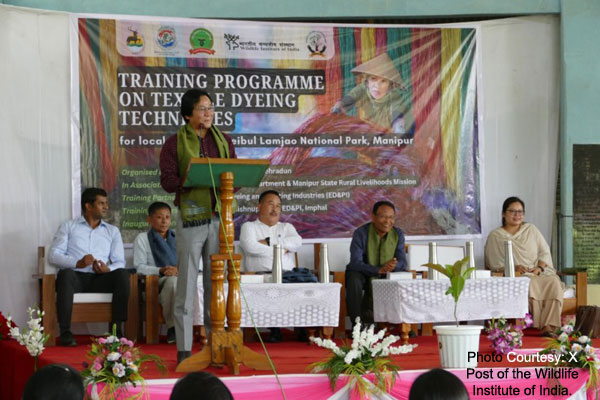
Manipur has linked traditional textile skills with wildlife conservation through a new training programme near Keibul Lamjao National Park. The Wildlife Institute of India, Manipur Forest Department and MSRLM are supporting local women to create sustainable livelihoods while protecting the habitat of the endangered Sangai deer.
Quick Glance: Key Entity Highlights
- 45 women from communities near Keibul Lamjao National Park are participating in specialised textile training.
- The programme focuses on natural dyeing, cotton and silk processing, and modern textile techniques.
- Sangai deer, also known as the dancing deer, depends on the unique phumdi ecosystem.
- The initiative connects women entrepreneurship with biodiversity protection in Manipur.
From Phumdis to Fabrics: How Indigenous Skills Are Becoming a Conservation Strategy
Agartala: The protection of Manipur’s iconic Sangai deer is now moving beyond conventional wildlife management. A new initiative is connecting indigenous textile traditions with ecological preservation around Keibul Lamjao National Park.
According to an X Post of ‘The Wildlife Institute of India (WII)“, the programme is designed to create alternative livelihood opportunities for communities living near the fragile wetland ecosystem. The idea is simple: when local families gain sustainable income sources, pressure on natural resources can gradually decrease.
Keibul Lamjao National Park in Bishnupur district holds global importance as the world’s only floating national park. Its floating vegetation system, known as phumdis, supports the survival of the critically endangered Sangai (Rucervus eldii eldii).
The deer is popularly called the “dancing deer” because of its unique movement across the soft floating landscape. However, protecting this habitat requires balancing conservation goals with the daily needs of nearby communities.
Furthermore, the latest textile training programme represents a community-based conservation approach. Instead of separating people from protected landscapes, the initiative aims to involve them directly in safeguarding biodiversity.
Women Artisans at the Centre of Green Economic Change
The 10-day specialised training programme focuses on empowering 45 local women living around the national park area. The training aims to convert traditional skills into sustainable micro-enterprises.
Speaking to the media including Enewstime Desk, officials confirmed that the programme includes advanced textile dyeing methods and practical knowledge needed for market-oriented production.
Participants are being trained in eco-friendly textile processing, including natural vegetable dyeing techniques. These methods use plant-based materials such as local flowers, bark and other natural resources to create chemical-free colours.
In addition, the programme covers cotton and silk fibre handling. The objective is to improve product quality while preserving the cultural identity of Manipuri textile traditions.
The training also introduces modern design approaches. Traditional patterns are being combined with contemporary textile formats to increase market opportunities.
Consequently, women artisans can potentially access ethical fashion markets while maintaining connections with local heritage.
| Initiative Component | Details |
|---|---|
| Training Duration | 10 days |
| Beneficiaries | 45 local women |
| Focus Area | Sustainable textile production |
| Main Skills | Natural dyeing, fibre processing, design integration |
| Conservation Link | Reducing pressure on Sangai habitat |
Protecting Loktak’s Ecosystem Through Livelihood Security
The Sangai’s survival depends heavily on the health of the phumdi ecosystem. These floating masses contain vegetation, soil and organic material that create the unique environment of Keibul Lamjao.
However, nearby communities have historically depended on natural resources for activities such as fishing, collecting materials and other daily needs. Therefore, conservation efforts must consider social and economic realities.
This initiative attempts to address that challenge by creating income opportunities outside direct dependence on the protected ecosystem.
Furthermore, sustainable textile enterprises could provide families with additional financial stability. This may encourage stronger community participation in conservation activities.
The collaboration between the Wildlife Institute of India, Manipur Forest Department and Manipur State Rural Livelihoods Mission reflects a broader shift in environmental management.
According to our Reporter in Manipur, the programme highlights how local communities can become conservation partners when economic opportunities are aligned with environmental goals.
State Institutions Push Community-Based Conservation Model
The programme was launched with participation from senior officials associated with wildlife protection and rural livelihood development.
The inaugural event included:
| Representative | Position |
|---|---|
| L. Joykumar Singh | Chief Conservator of Forests (Wildlife), Manipur |
| L. Biramangol Singh | President & Deputy Conservator of Forests (Park & Sanctuary) |
| Khamba Ronglo | State Mission Manager (Livelihoods), MSRLM |
Officials emphasised that women’s economic empowerment can strengthen environmental protection at the grassroots level.
Furthermore, the programme demonstrates a model where conservation and development work together rather than competing with each other.
Traditional crafts, when connected with sustainable markets, can create new opportunities for rural communities.
News Analysis: Enewstime Desk Perspective
The Manipur textile initiative represents a significant change in conservation thinking. Earlier approaches often focused mainly on protecting wildlife boundaries. However, modern conservation increasingly recognises the importance of community participation.
From an administrative perspective, training programmes must eventually translate into stable income generation. The success of this model will depend on long-term support, market access and continuous skill development.
The Sangai remains one of Manipur’s strongest ecological symbols. Protecting it requires cooperation between forest authorities, local residents and livelihood institutions.
Furthermore, linking cultural identity with conservation could strengthen public ownership of environmental protection.
If successful, the model could provide lessons for other biodiversity-sensitive regions where communities and ecosystems share the same landscape.
The future of Sangai conservation may not depend only on protecting forests and wetlands. It may also depend on empowering the people who live beside them.
The initiative also reflects a larger Northeast India trend where indigenous knowledge systems are being connected with modern economic opportunities. Indigenous communities of Nagaland have successfully preserved a deep connection between communities and nature through traditional ecological knowledge. In Nagaland, Zabo System of Phek district and Khonoma village’s community-led conservation model highlight the power of local wisdom in protecting the environment.
According to Climate experts associated with Enewstime Desk, can traditional skills change the future of Sangai Conservation in Manipur and preserve the delicate ecological system in other States in the Northeast Region.