

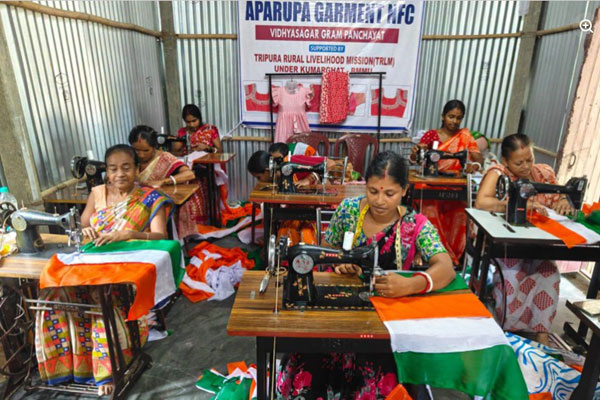
As Har Ghar Tiranga expands across Tripura, self-help group (SHG) Didis are emerging as important participants in the economic ecosystem of the campaign. Their flag-making work shows how national celebrations can create short-cycle business opportunities for rural women. With timely orders, fair pricing and better production support, the Tiranga campaign could become a stronger platform for women-led micro-enterprises and local economic integration. CM Dr Manik Saha launched the campaign in Tripura.
Quick Glance
- SHG Didis in Tripura are stitching national flags for the Har Ghar Tiranga campaign.
- Tripura CM Dr Manik Saha launched the campaign on August 12, 2026.
- Timely institutional orders could give SHGs predictable seasonal business.
- Better pricing, machinery and coordinated procurement could increase production capacity.
- The model can connect patriotic campaigns with women’s income and rural enterprise.
Har Ghar Tiranga Creates a Micro-Enterprise Opportunity
Agartala/Dharmanagar August 13: The Har Ghar Tiranga campaign is primarily a national celebration. However, its large-scale demand for flags also creates an economic opportunity.
Tripura’s SHG Didis are showing how that opportunity can reach rural households. Women who already possess tailoring skills can take up flag production without creating an entirely new livelihood model.
This approach reduces the distance between public campaigns and local enterprise.
The economic logic is straightforward. A campaign creates demand. Local SHGs supply the product. Payments generate income. The same income circulates within rural communities.
That makes flag production more than a seasonal patriotic activity. It can become a short-cycle micro-enterprise when procurement, production and payments work together.
CM Launches Har Ghar Tiranga Rally in Tripura
The wider campaign received a major push in Tripura with Chief Minister Prof. (Dr.) Manik Saha inaugurating a Har Ghar Tiranga rally from the Ujjayanta Palace premises.
The rally moved through the city’s main roads before concluding at Rabindra Satabarshiki Bhavan. A Tiranga Exhibition and Tiranga Concert were also organised at the venue.
| From archive: Har Ghar Tiranga a tribute to martyrs: Tripura CM |
Addressing the gathering, Saha said the national flag represents India’s freedom, strength, peace and progress. He urged citizens to uphold the dignity and honour of the national flag.
Dharmanagar SHG Shows Both Potential and Constraints
The experience of Udyog SHG in Dharmanagar illustrates the potential clearly.
The group has 13 members and was formed around five years ago. Its women undertake tailoring along with candle-making, abir production and food supply.
This year, the group has received an order for around 500 national flags. The women are working intensively to complete the order before Independence Day. Yet the group faces a basic production constraint.
Only two members currently have sewing machines. Financial limitations have prevented most members from purchasing their own machines. Therefore, the women have to share the available equipment and work in shifts.
That limits the speed at which the group can respond to larger orders.
The situation also reveals an important point for policymakers. Demand alone does not create a viable rural enterprise. Production capacity must grow alongside demand.
Timely Orders Can Change the Economics
For SHG-based manufacturing, timing matters.
A national campaign such as Har Ghar Tiranga has a predictable annual cycle. Authorities know that demand will rise before Independence Day.
That creates an opportunity to place institutional orders well in advance.
Early orders would allow SHGs to plan raw materials, labour, machine usage and delivery schedules. Women could also coordinate production between different groups instead of depending on a small number of sewing machines.
Late orders, by contrast, can compress the entire production cycle. Women then have to work longer hours while equipment becomes a bottleneck.
A planned procurement calendar could therefore improve both productivity and earnings.
Tripura has already moved towards involving SHGs in meeting additional flag demand. The state has also revised flag rates to encourage SHG participation and urged people to purchase flags from SHG stalls.
Fair Pricing Is Central to Economic Integration
The price of a flag is not simply a procurement figure for an administration.
For an SHG, it determines whether production is commercially worthwhile.
The price must account for fabric, thread, labour, electricity, machine use, transport and other production costs. It should also leave a reasonable margin for the women who make the product.
A sustainable pricing policy can encourage more SHGs to enter the production cycle.
That would create a decentralised supply network. Instead of depending on a few large producers, procurement could reach multiple women-led micro-enterprises across districts.
Such a model would also distribute campaign-related economic activity more widely.
Machinery Can Unlock Higher Production
The Udyog SHG example highlights another priority: productive assets.
Two sewing machines cannot support large-scale production efficiently. Additional machines would allow more members to work simultaneously.
The same principle can apply across SHGs.
Instead of treating sewing machines only as welfare assets, policymakers can view them as productive infrastructure. A machine can generate income across multiple government and private orders after the Independence Day season ends.
This creates a stronger case for equipment support linked to business plans, training and market access.
TRLM’s broader mandate already focuses on the social and economic empowerment of rural women through community-based and livelihood-focused institutions.
From Seasonal Orders to Year-Round Enterprise
The bigger opportunity lies beyond August 15.
Flag-making can provide an entry point into a broader micro-enterprise ecosystem. Once groups improve their tailoring capacity, they can take up institutional uniforms, bags, garments, banners, community-event materials and other textile products, subject to applicable procurement rules.
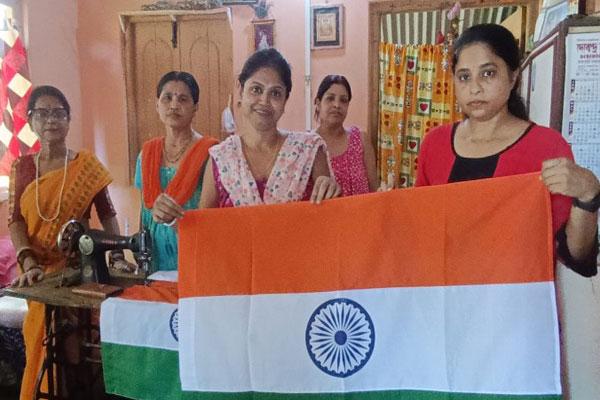
Har Ghar Tiranga campaign has created opportunities for micro-enterprises.
This can reduce dependence on a single seasonal market.
The economic model would then shift from campaign-based production to enterprise-based production.
That transition requires market linkages. SHGs need information about upcoming tenders, institutional requirements, quality standards, pricing and delivery schedules.
The 2026-27 rural entrepreneurship planning of the TRLM has also placed emphasis on strengthening livelihood infrastructure and rural enterprises, providing a broader policy context for such initiatives.
Har Ghar Tiranga Can Become a Local Economic Model
Tripura’s Har Ghar Tiranga campaign demonstrates how national programmes can generate local economic value when communities participate in production.
The state’s campaign is running from August 9 to August 17, with rallies, exhibitions, concerts and other activities planned across different levels of administration.
The participation of SHG Didis adds an economic dimension to these celebrations.
Every flag stitched locally creates a small transaction. Thousands of such transactions can form a meaningful livelihood opportunity when procurement is decentralised and organised.
The model therefore connects three objectives: patriotism, women’s empowerment and rural enterprise.
The Next Step Is Scaling the Model : Editor-in-Chief’s Perspective
The Udyog SHG’s 500-flag order is modest in absolute terms. Its significance, however, lies in what the example represents.
If similar orders reach SHGs across Tripura, production can become more decentralised. If rates reflect actual production costs, women can earn better returns. If machines and training improve capacity, groups can handle larger orders.
Most importantly, regular institutional procurement can give rural micro-enterprises a predictable market.
That is where Har Ghar Tiranga can move beyond a one-week national campaign.
For SHG Didis from, the Tiranga can represent both national pride and economic opportunity. With better economic integration, the hands stitching the national flag can also become the hands building stronger rural enterprises.