

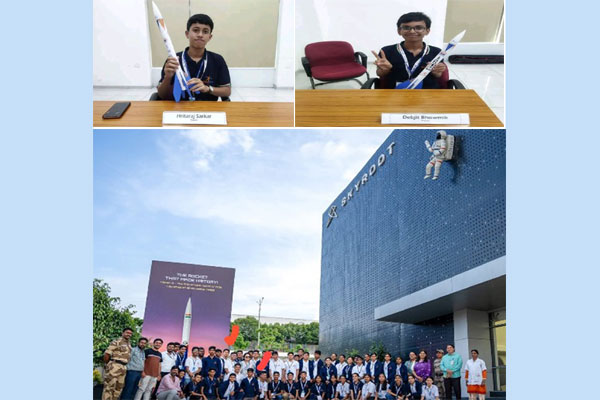
For two schoolchildren from Tripura, the most powerful lesson in rocket science did not come from a textbook. It came from standing inside a facility where engineers were turning drawings, materials and calculations into a machine designed to leave Earth. Debjit and Hritaraj entered Skyroot Aerospace as curious students during YUVIKA 2025. They left with a new way of looking at science, technology and their own possibilities. President’s awardee Teacher, Bidisha Majumder narrates.
Key Takeaways
- Debjit and Hritaraj of Hariananda English Medium H.S. School from Tripura experienced practical rocket science during the ISRO YUVIKA programme.
- Their Skyroot Aerospace visit showed how carbon composites, 3D printing, propulsion and precision combine to build launch vehicles.
- The 2026 success of Vikram-I gave new meaning to a 2025 educational journey that introduced the students to India’s private space sector.
The Day a Rocket Became Real
Agartala August 21: A rocket can look very different when seen through the eyes of a schoolchild.
On a page, it is a diagram.
On television, it is a bright trail rising into the sky.
Inside a rocket company, however, it becomes a completely different experience.
It becomes metal, carbon fibre, wires, electronics, engines, software, measurements and endless testing.
That was the experience of Debjit and Hritaraj, students of Hariananda English Medium H.S. School in Agartala, when they visited Skyroot Aerospace in Hyderabad during the ISRO YUVIKA programme in 2025.
I was with them as their teacher and guide.
I watched their questions grow as they moved through the aerospace facility.
They were not simply looking at a rocket.
They were trying to understand how such a complex machine could be built.
At that time, Vikram-I was still part of Skyroot Aerospace engineering and testing efforts.
On July 18, 2026, the story reached a historic point when Vikram-I lifted off from the Satish Dhawan Space Centre in Sriharikota and successfully reached orbit.
For Debjit and Hritaraj, the event added a remarkable new chapter to a journey that had started more than a year earlier.
They had seen the people, technologies and manufacturing processes behind a private Indian rocket.
Then they watched that dream reach space.
A Teacher Watches Curiosity Take Flight
As their teacher and guide, I believe the greatest value of YUVIKA lies in what happens after the programme ends.
A student may remember a visit for a few days.
But sometimes, one experience changes the way that student thinks.
That is what happened with Debjit and Hritaraj.
Their Skyroot visit made science tangible.
They could connect classroom concepts with real engineering.
They could see that a rocket does not emerge from one brilliant idea.
It comes from thousands of ideas working together.
That was perhaps the first major lesson.
Space science is not only about astronauts and launches.
It is also about people who design structures.
It is about engineers who develop engines.
It is about technicians who work with precision.
It is about programmers who write control systems.
It is about scientists who test materials.
And it is about young students who begin by asking questions.
The Question Behind Every Big Innovation
The story of Skyroot Aerospace offered another lesson.
Big achievements often begin with a simple question.
Why not?
Why should a private Indian company not build a launch vehicle?
Why should advanced manufacturing remain limited to traditional methods?
Why should young engineers not attempt difficult technologies?
Skyroot was founded by Pawan Kumar Chandana and Naga Bharath Daka. Chandana had earlier worked as an ISRO scientist before entering the world of private space technology.
For students, his journey carries an important message.
A career in science does not always follow one straight road.
Knowledge can move from a research institution to a start-up.
Engineering can become entrepreneurship.
A scientific idea can become a company.
And a school project can someday become a serious technology venture.
Debjit and Hritaraj were still very young.
Yet the environment around them showed that age does not prevent anyone from asking ambitious questions.
They Discovered That a Rocket Is More Than an Engine
One of the most important things the students learned was the complexity hidden behind a launch vehicle.
Before the visit, a rocket could easily appear to be one machine.
At Skyroot, that idea changed.
A launch vehicle contains many interconnected systems.
The main structure must remain strong.
The propulsion system must generate enormous thrust.
Avionics must monitor the vehicle.
Electronics must communicate with different systems.
Thermal protection must safeguard critical components.
Manufacturing must meet strict specifications.
Testing must expose possible weaknesses before launch.
Everything must work together.
One failure can affect the entire mission.
For Debjit and Hritaraj, this became a lesson in teamwork.
It also connected several school subjects.
Physics explains motion and thrust.
Mathematics supports calculations.
Chemistry helps explain materials and propellants.
Computer science contributes to control and data systems.
Engineering brings these disciplines together.
A rocket, therefore, becomes a meeting point for many branches of knowledge.
The Carbon Fibre Question
Among the technologies that caught the attention of the students was carbon fibre.
Their curiosity was straightforward.
Why use such a material for a rocket?
The answer lies in one of the biggest challenges of aerospace engineering.
Weight matters.
A rocket has to lift its own structure along with fuel, engines and payload.
Every unnecessary kilogram adds to the challenge.
Engineers therefore look for materials that can provide high strength without excessive weight.
Skyroot has used carbon-composite structures in its Vikram launch vehicle family.
For Debjit and Hritaraj, carbon fibre became more than a technical term.
It became an example of how material science can influence the performance of an entire spacecraft.
They began to understand that even a seemingly small engineering decision can have consequences far beyond one component.
That is how classroom learning becomes real.
When 3D Printing Entered the Rocket Story
The students were equally fascinated by 3D printing.
For many children, a 3D printer is associated with making models.
At Skyroot, additive manufacturing has a much more serious purpose.
The technology can help engineers create complex components with greater design flexibility.
Skyroot has used 3D-printed components in propulsion technology, including its liquid-engine systems.
For the students, this connected several worlds at once.
A digital design could become a physical component.
A computer model could become part of a rocket.
Manufacturing could directly support propulsion.
That was a powerful lesson in interdisciplinary learning.
Debjit and Hritaraj could see that school subjects do not exist in isolated boxes.
A computer can help design an engineering component.
Physics can explain how it works.
Materials science can determine what it should be made from.
Manufacturing can turn the design into reality.
Together, they can contribute to a rocket.
The Cleanroom Taught Them About Invisible Details
Not everything at Skyroot looked dramatic.
Some of the most important lessons came from the quiet side of aerospace manufacturing.
The students wanted to understand why cleanrooms are needed.
The answer introduced them to a side of rocket science that rarely appears in launch videos.
Precision.
Cleanliness.
Control.
Patience.
Modern aerospace systems can require highly controlled environments because tiny contaminants can affect sensitive components.
That means rocket science is not only about powerful engines.
It is also about dust particles.
It is about measurements.
It is about tolerances.
It is about following procedures correctly.
The spectacular launch that people see lasts only a short time.
The preparation behind it can take months or years.
That contrast stayed with me as a teacher.
The sky may witness the final few minutes.
Engineers spend countless hours preparing for them.
The Meaning Behind the Name Vikram
There was also a deeper historical connection.
The name Vikram recalls Dr. Vikram Sarabhai, one of the principal architects of the Indian space programme.
Sarabhai believed advanced technology should address real problems and contribute to national development.
Dr. A.P.J. Abdul Kalam, another towering figure in Indian science, repeatedly encouraged young people to dream and turn those dreams into action.
For schoolchildren, these ideas can sometimes feel distant.
At Skyroot, they became more immediate.
A company was building rockets named Vikram.
Young engineers were working on space technology.
And school students were walking through the same technological ecosystem.
The connection between India’s scientific past and its private space future became visible before them.
When Vikram-I Turned Their Memory Into History
The significance of the 2025 visit became much greater in July 2026.
Vikram-I successfully reached orbit after launching from Sriharikota.
The mission represented an important step in the growth of private participation in the Indian space sector.
For Debjit and Hritaraj, it was also deeply personal.
They had seen the story before the launch.
They had visited the environment where the technology was being developed.
They had listened to explanations.
They had seen equipment.
They had asked questions.
Now they could watch the rocket perform its ultimate task.
For me, this is where education becomes truly meaningful.
The students did not simply learn about a successful launch.
They could connect the launch with an experience they had personally lived.
Their textbook had acquired a memory.
The Story Does Not End With Vikram-I
Another lesson from Skyroot is that technological progress never stops with one achievement.
The company is already working on the next generation of its Vikram launch vehicle family.
Vikram-II is aimed at carrying larger payloads to Low Earth Orbit.
The company is also exploring advanced manufacturing, artificial intelligence, reusable technologies and higher launch frequency.
This matters for students because innovation is a continuous process.
One successful mission does not end the journey.
It creates another question.
What can be improved?
What can be made faster?
What can be made safer?
What can be made more affordable?
What can be built next?
Those questions are at the heart of scientific progress.
The Lesson I Want Them to Carry Forward
As their teacher, I do not want Debjit and Hritaraj to remember only the machines they saw.
I want them to remember the feeling of curiosity.
I want them to remember that every complex machine begins with an idea.
I want them to understand that failure is part of experimentation.
I want them to believe that a student from a classroom in Agartala can think about problems that extend far beyond the classroom.
Perhaps one day, their generation will work on satellites.
Perhaps they will develop artificial intelligence.
Perhaps they will design new materials.
Perhaps they will build spacecraft.
Or perhaps they will solve a completely different problem.
The field does not matter as much as the mindset.
Ask questions.
Learn deeply.
Experiment.
Build.
Improve.
Try again.
From Two Students to a Larger Dream
When Debjit and Hritaraj entered Skyroot Aerospace in 2025, they went there as schoolchildren.
They were curious.
They were excited.
They wanted to see how rockets were made.
They returned with something more valuable than photographs or memories.
They returned with a different understanding of science.
They saw how carbon composites can make structures lighter.
They saw how additive manufacturing can contribute to propulsion.
They learned why precision and cleanliness matter.
They discovered that a rocket requires many disciplines and many people.
Most importantly, they saw that ambitious technology can emerge from an Indian private company.
Then Vikram-I reached orbit.
That moment gave their earlier experience a new meaning.
They had not simply visited a workplace.
They had glimpsed a technological future before it became a headline.
As I look back on their YUVIKA journey, one thought remains particularly strong.
Children do not always need bigger lessons.
Sometimes they need a real experience that makes a lesson impossible to forget.
For Debjit and Hritaraj, that experience came in a rocket facility in Hyderabad.
They entered through a door as students.
They walked out with their eyes turned towards the sky.
And perhaps that is the real purpose of education.
Not simply to tell children what the world is.
But to make them wonder what they can build for it.
