

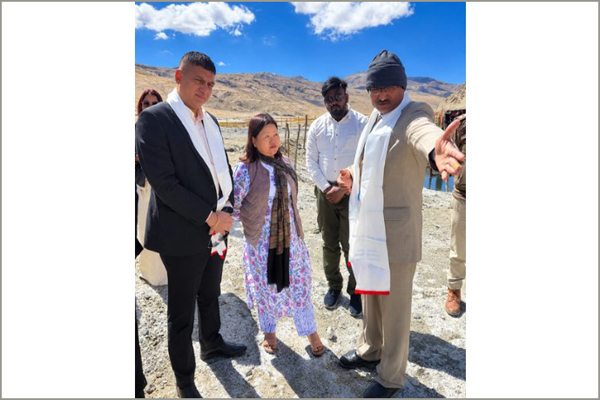
Science and Technology Minister Dasanglu Pul visited the Geothermal Project of ONGC at Puga Valley in Ladakh on October 3 with senior scientists and departmental geologists to study exploration, drilling and clean-energy generation techniques applicable to Tawang in Arunachal Pradesh’s Himalayan terrain.
Key Takeaways
- Arunachal Pradesh is examining geothermal energy for clean and reliable power in remote border areas.
- The Mago-Thingbu belt in Tawang has an estimated geothermal potential of 10-15 MW.
- Scientific surveys and pre-feasibility studies cover five geothermal sites in Tawang.
Arunachal Pradesh is intensifying its assessment of geothermal resources in Tawang as the state explores clean and locally generated power options for remote and strategically important border areas.
Tawang Emerges as Key Geothermal Energy Prospect
The Mago-Thingbu belt in Tawang district has emerged as an important area in Arunachal Pradesh’s geothermal exploration programme.
The state estimates that the belt could have geothermal potential of around 10-15 MW.
The government is examining geothermal energy as a possible source of clean, reliable and locally generated power. The focus is particularly strong on remote and strategically located border areas.
Geothermal resources could also support uses beyond electricity generation. These include heating and cooling, agricultural produce drying and other clean-energy applications suited to local requirements.
Minister Visits Puga Valley Project
Pul visited the ONGC Geothermal Project at Puga Valley in Ladakh along with Centre for Earth Sciences and Himalayan Studies (CESHS) Director Tana Tage and departmental geologists.
The team studied geothermal exploration and drilling activities at the high-altitude project. It also examined the process of generating clean energy under Himalayan conditions.
The visit is significant for Arunachal Pradesh as the state continues to assess the feasibility of developing its own geothermal resources.
The experience from Puga could provide useful technical insights for similar high-altitude locations in Arunachal Pradesh.
Scientific Studies Continue in Tawang
Arunachal Pradesh has been conducting scientific investigations into its geothermal resources for several years.
In March 2024, CESHS collaborated with the Norwegian Geotechnical Institute and Iceland-based Geotropy for field investigations in the state.
The teams conducted geological structural mapping at hot-spring sites in Mago, Thingbu and other locations.
The studies aim to assess the geothermal resources and determine their potential applications. Electricity generation remains one of the key possibilities.
Researchers are also examining applications such as heating, cooling and drying agricultural produce. These uses could help adapt geothermal energy to local requirements.
Five Sites Under Investigation
CESHS and government-owned Oil India Limited subsequently moved towards pre-feasibility studies in Tawang district.
The studies involve both surface and subsurface investigations. Mago, Thingbu, Damteng and Tsechu are among the locations covered by the work.
The Centre has also reported field investigations at five geothermal sites in Tawang.
These sites are Damteng, Grengkhar, Mago, Thingbu and Tsechu.
Researchers collected samples from the locations for geochemical analysis. The findings will help assess the nature and potential of the geothermal resources.
The ongoing investigations are intended to establish a clearer scientific basis for possible geothermal development in the state.
Focus on Remote Border Regions
The geothermal initiative carries particular significance for Arunachal Pradesh because of its difficult Himalayan terrain and strategically located border regions.
Locally generated energy could offer an additional clean-power option for remote areas.
Pul said Arunachal Pradesh has extensive natural resources and wants to utilise them responsibly.
“Arunachal Pradesh is endowed with vast natural resources, and our goal is to utilise this potential responsibly to build a sustainable future,” she said.
She said the experience gained from the Puga project would strengthen Arunachal Pradesh’s efforts to explore geothermal energy.
Pul specifically highlighted the relevance of geothermal power for remote and strategically important border areas.
Technical Expertise to Aid Exploration
Pul also appreciated ONGC and its execution partner SEROS for sharing their technical expertise and field experience.
The interaction at Puga Valley allowed the Arunachal team to gain practical insights into geothermal exploration and development in a high-altitude Himalayan setting.
Arunachal Pradesh will now continue its scientific assessment and pre-feasibility work at identified geothermal sites.
The findings from these investigations will help determine the scope for electricity generation and other clean-energy applications.
With an estimated 10-15 MW potential in the Mago-Thingbu belt and studies underway at five sites, Tawang remains a key focus of Arunachal Pradesh’s efforts to explore geothermal energy as a clean and locally available power source. (Edited by Enewstime Desk)