

The Tripura government and IIT Kharagpur have agreed to explore cooperation in higher education, research and technology, with plans for a five-year project framework covering emerging technologies, teacher training, institutional collaboration and research opportunities linked to the state’s economic potential.
Key Takeaways
-
Tripura signs an LoI with IIT Kharagpur to strengthen higher education, research and technological skills.
-
The proposed partnership will focus on AI, data science, teacher training, innovation and entrepreneurship.
-
A Joint Steering Committee, nodal officers and a five-year project report are among the proposed next steps.
Tripura has taken a major step towards strengthening higher education by signing a Letter of Intent (LoI) with IIT Kharagpur. The proposed partnership aims to expand research, improve technological skills and create new academic opportunities for students across the state.
The initiative will focus on emerging technologies, innovation, teacher training and entrepreneurship. It also seeks to strengthen cooperation between IIT Kharagpur and Tripura’s higher education institutions.
The state government views the partnership as an important step towards its goal of developing Tripura as the “Education Hub of the Northeast”.
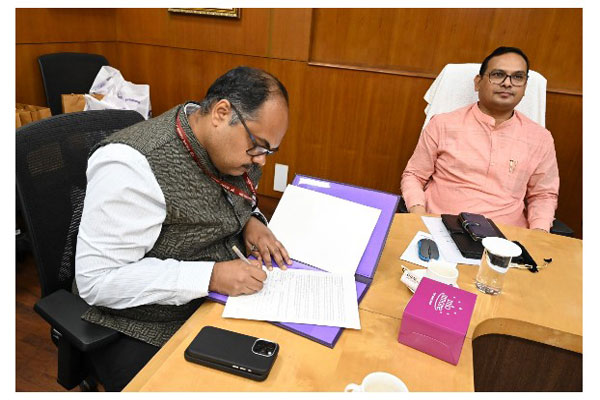
IIT Kharagpur Director Professor Suman Chakraborty, Higher Education Department Secretary Vikas Singh, IAS, Higher Education Director Animesh Debbarma and other officials attended the meeting where the LoI was signed.
Partnership to Focus on AI and Data Science
The meeting covered several areas of potential cooperation. These included higher education development, research expansion, artificial intelligence (AI), data science, innovation and entrepreneurship.
The participants also discussed ways to improve teachers’ skills through capacity-building initiatives.
The proposed collaboration aims to help students gain access to advanced technical knowledge and research opportunities. It also seeks to prepare them for developments in emerging technologies and strengthen their ability to pursue academic and professional opportunities.
Kishor Barman, Tripura Minister for Higher Education, Panchayat and General Administration (Political), described the agreement as a historic moment for the state.
“Today is truly a historic and proud day for Tripura. A leading institution like IIT Kharagpur has extended its hand to support the development of higher education in our state,” Barman said.
He said the LoI was more than a formal step. According to the minister, it marks the beginning of efforts to create new opportunities for students, improve educational quality and advance research and technological skills.
State Universities and Colleges in Focus
The proposed partnership could strengthen links between IIT Kharagpur and Tripura Technical University, degree colleges and other higher education institutions in the state.
These connections could support greater academic cooperation and improve access to advanced research and technology-based education.
The government also wants teachers to receive better training and educational institutions to work more closely with one another. Such cooperation could help strengthen teaching capabilities and encourage research across the state’s higher education system.
Barman said the government wanted students from Tripura to demonstrate their capabilities at the national level in modern technology, AI, data science and research.
He also highlighted the importance of expanding employment and entrepreneurship opportunities. The proposed partnership aims to connect academic learning with skills that students can use in their future careers.
Joint Steering Committee and Five-Year Plan Proposed
The meeting discussed several steps to move the collaboration forward.
These include forming a Joint Steering Committee, appointing nodal officers from both sides and preparing a Detailed Project Report (DPR) for the next five years.
The proposed committee would help coordinate cooperation between the two sides. The nodal officers would support communication and coordination, while the DPR would provide a framework for planning future initiatives.
The participants also discussed how research, innovation and skill development could align with Tripura’s needs and development potential.
Another priority is to strengthen links between educational institutions, industry and entrepreneurship. The government aims to make higher education more research-oriented, technology-driven and employment-focused.
The specific projects and implementation timelines will depend on the subsequent planning process.
Research Opportunities in Agriculture, Bamboo and Rubber
The collaboration could also explore the application of technology and research in sectors with development potential in Tripura.
Agriculture, bamboo, rubber and food processing are among the areas identified for possible cooperation.
Research and technological applications in these sectors could create opportunities for innovation, skill development and entrepreneurship. They could also help connect academic knowledge with practical requirements in local industries.
The proposed partnership seeks to make research more relevant to the state’s economic priorities. It could encourage educational institutions to explore technological solutions suited to local needs and emerging business opportunities.
The focus on these sectors also reflects the government’s broader aim of linking education and research with employment and entrepreneurship.
Tripura Seeks Stronger Research and Technical Education
The LoI marks an important step in the state’s efforts to modernise higher education and strengthen research capabilities through cooperation with a leading national institution.
The proposed partnership covers emerging technologies, teacher training, institutional cooperation, innovation and industry-oriented research. Its next steps include establishing coordination mechanisms and preparing a five-year project plan.
Through the initiative, the government aims to improve educational quality and expand opportunities for students, teachers and researchers.
The agreement also supports the ambition of the State to develop as an education hub for the Northeast. The proposed cooperation could help strengthen the state’s academic institutions and build a stronger foundation for technology-driven education, research and employment.
