

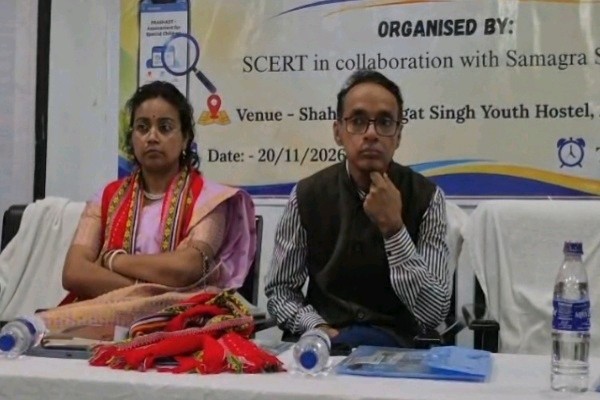
Samagra Shiksha and SCERT organised a training programme at Shaheed Bhagat Singh Youth Hostel in Agartala on November 20 to familiarise education officials with PRASHAST implementation in Tripura, while highlighting financial and administrative priorities for the remaining months of the 2026–27 financial year.
At A Glance:
-
Samagra Shiksha and SCERT jointly organised the PRASHAST training programme at Shaheed Bhagat Singh Youth Hostel in Agartala on November 20.
-
The workshop focused on identifying and assessing children with special needs and strengthening inclusive education.
-
Officials stressed the need to utilise 75% of allocated funds by December 15 to qualify for the next instalment under the new SNA-SPARSH system.
A training programme on identifying and assessing children with special needs under the PRASHAST initiative brought education officials and stakeholders together in Agartala on November 20. The workshop also highlighted an urgent financial target for the Education Department, with officials stressing that implementing agencies must utilise at least 75% of allocated funds by December 15 to qualify for the next instalment.
Samagra Shiksha and the State Council of Educational Research and Training (SCERT) jointly organised the programme at Shaheed Bhagat Singh Youth Hostel. The session began at 11 am on November 20.
The discussions covered the implementation of PRASHAST, inclusive education and the challenges of fund utilisation under the newly introduced SNA-SPARSH system.
PRASHAST Training to Strengthen Inclusive Education
The training aimed to familiarise participants with the process of identifying and assessing children with special needs through the PRASHAST system.
It also focused on the educational support required by these children to ensure their meaningful participation in the learning process.
The initiative seeks to strengthen inclusive education and promote equal learning opportunities for every child, irrespective of individual learning requirements.
Speakers said the subjects scheduled for discussion at the workshop would remain among the Education Department’s major priorities over the next two to three months.
They stressed the need for coordinated efforts to complete the department’s programmes and projects within the current financial year.
Education Department Faces Four-Month Implementation Window
Officials pointed out that government departments follow the April-to-March financial year cycle. They must complete their respective projects and programmes within this period.
With November approaching its end, the Education Department has only four months, from December through March, to complete the remaining activities.
Speakers said the limited time made timely implementation particularly important. They urged participants to pay close attention to the issues discussed during the workshop, as these would influence the department’s work over the coming months.
SNA-SPARSH Introduces a New Fund Management System
The workshop also addressed difficulties arising from the introduction of SNA-SPARSH, a digital fund management system administered by the Finance Department of the Tripura Government.
The system handles the flow and disbursement of funds under Centrally Sponsored Schemes (CSS). Its introduction has brought changes to the earlier fund transfer mechanism.
Speakers said the new system was taking time to stabilise because it involved a different payment process. They compared it with the Public Financial Management System (PFMS), through which departments could transfer funds relatively easily until the previous financial year.
The department received the funds towards the end of September. Authorities are now releasing the allocations to implementing agencies in phases.
Officials acknowledged that introducing a new financial mechanism could initially create technical difficulties and uncertainties. However, they said these challenges should not delay the utilisation of available funds.
75% Fund Utilisation Target Set for December 15
Fund utilisation emerged as one of the most important issues discussed at the workshop.
Speakers made it clear that implementing agencies must spend at least 75% of their allocated funds by December 15. Failure to meet this target could prevent the department from receiving its next instalment.
The expenditure target covers several components of the education programme. These include building construction, vocational training, smart classrooms and the supply of educational materials.
Officials warned that failure to secure the next instalment could create financial constraints during the remaining months of the financial year.
Without fresh funds, the department might have to depend on the unutilised balance of existing allocations to continue its activities and complete pending work.
They cautioned that such a situation could affect the pace of programme implementation, even if stakeholders initially failed to notice the financial constraints.
Officials Urged to Prioritise Timely Spending
Speakers described fund utilisation as a critical priority because the department has limited time to meet its annual targets.
They urged officials and implementing agencies to understand the financial implications of missing the December 15 deadline.
The workshop therefore addressed both educational and administrative priorities. While PRASHAST seeks to improve the identification and educational support of children with special needs, timely fund utilisation remains essential to implementing the department’s wider programmes.
The organisers expect the training initiative to contribute to stronger inclusive education practices and more effective implementation of education schemes across Tripura.
