

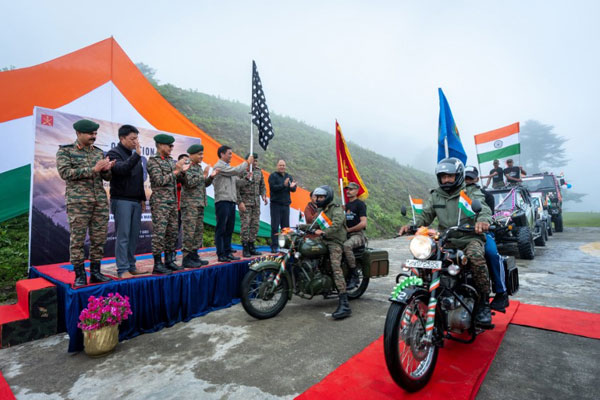
Arunachal Pradesh witnessed two contrasting frontier developments as Operation Arunoday, a joint Indian Army and NIMAS expedition, opened a trekking route from Thingbu Village to 5,583-metre Bajrang Peak, while an Army truck accident in Dirang claimed one soldier’s life on June 27, 2026.
Quick Glance: Key Developments
- Operation Arunoday aims to promote responsible adventure tourism in Arunachal Pradesh.
- Indian Army and NIMAS jointly launched the Thingbu Village–Bajrang Peak expedition.
- Bajrang Peak stands at an altitude of 5,583 metres in the Himalayan frontier.
- Subedar Surendar Singh died after an Army vehicle accident in West Kameng district.
Agartala/Itanagar: The remote Himalayan landscape of Arunachal Pradesh is witnessing a new chapter of exploration with the launch of Operation Arunoday, a civil-military initiative designed to showcase the state’s adventure tourism potential.
The expedition focuses on opening a trekking route between Thingbu Village and Bajrang Peak. The peak rises to 5,583 metres, making the route a significant attraction for high-altitude adventure activities.
According to the Arunachal Pradesh Chief Minister’s official communication, the initiative is not only about accessing a remote frontier area. It also aims to encourage responsible tourism and create opportunities for communities living in these difficult terrains.
Furthermore, the involvement of the Indian Army and National Institute of Mountaineering and Allied Sports (NIMAS) highlights the growing connection between adventure, local development and frontier engagement.
Information gathered by Enewstime’s local desk from the region reveals that such initiatives are increasingly focusing on bringing remote areas into the tourism map while maintaining ecological responsibility.
The project presents a human story beyond mountains and expeditions. It reflects how local landscapes, community aspirations and national institutions are coming together to explore new possibilities.
Mountains of Opportunity and Challenges of Frontier Life
Arunachal Pradesh’s mountainous geography has always shaped the lives of its people. Remote villages often face challenges related to connectivity, economic opportunities and accessibility.
However, initiatives like Operation Arunoday attempt to create alternative economic pathways through tourism.
Adventure tourism can support local guides, homestays, transport services and small businesses. Consequently, opening new trekking routes may help generate income opportunities in areas that have traditionally remained away from mainstream economic activity.
At the same time, the Himalayan environment demands careful planning. High-altitude tourism requires safety measures, environmental protection and community participation.
The Bajrang Peak route represents both opportunity and responsibility. The success of such projects depends on balancing tourism growth with conservation.
Observing the situation from Arunachal Pradesh, an Enewstime correspondent noted that frontier development increasingly involves both physical connectivity and creating sustainable opportunities for local residents.
Dirang Army Accident Highlights Risks of Mountain Operations
While Arunachal Pradesh celebrated a new frontier initiative, the state also witnessed a tragic incident involving Army personnel in West Kameng district.
An Army truck belonging to the 18 Sikh Light Infantry met with an accident near Dirang on National Highway-13.
Officials stated that the vehicle lost control while negotiating a hilly stretch. The truck reportedly crashed through the chain-link fence of the 30 Battalion Sashastra Seema Bal (SSB) campus near PT Ground before rolling down a slope.
The Rapid Rescue Team of the 30 Bn SSB responded quickly after receiving information about the accident.
Rescue personnel removed the injured soldiers from the damaged vehicle. They were shifted for medical assistance at nearby facilities.
One soldier received initial treatment at the SSB Unit Medical Room before being referred to District Hospital, Bomdila. Another injured soldier was taken to the Community Health Centre in Dirang.
However, Subedar Surendar Singh succumbed to his injuries despite medical efforts.
The two injured personnel remain under treatment, and officials have reported their condition as stable.
Frontier Stories: Between Dreams, Duty and Sacrifice
The developments surrounding Operation Arunoday and the Dirang accident present two sides of life in Arunachal Pradesh’s frontier regions.
One side reflects ambition — young communities looking towards tourism, exploration and new economic opportunities.
The other side reflects duty — soldiers operating in challenging mountain conditions while serving in remote areas. Enewstime Desk opines, these events underline the importance of safety, preparedness and infrastructure in difficult terrains.
Mountain roads, unpredictable weather and geographical challenges continue to influence daily operations across the Himalayan region.
The investigation into the Dirang accident is underway, and authorities are working to determine the exact cause of the mishap.
News Analysis: Enewstime Desk’s Perspective
The launch of Operation Arunoday reflects a broader shift in frontier policy where remote regions are being viewed not only from a security perspective but also through development and tourism opportunities.
However, the Dirang accident reminds policymakers that frontier expansion must include stronger safety systems.
Arunachal Pradesh’s future growth depends on connecting remote communities while ensuring protection for those working in challenging environments.
The earthquake vulnerability of the Northeast remains another major consideration. Experts have repeatedly highlighted that the Himalayan and sub-Himalayan regions, including parts of Arunachal Pradesh and other northeastern states, fall within a seismically active zone.
Therefore, tourism infrastructure, roads and public facilities require earthquake-resilient planning.
Preparedness, scientific assessment and community awareness remain essential for reducing risks during natural disasters.
