

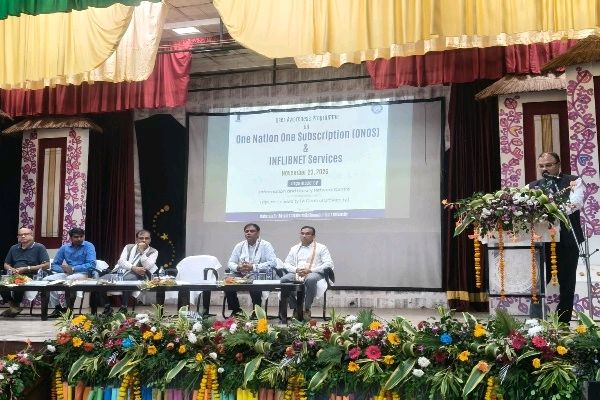
Tripura University has been given a State-level coordination role covering universities and colleges across Tripura through institutional support from its Centre’s One Nation One Subscription (ONOS) initiative and the INFLIBNET Centre. Vice-Chancellor Professor Debabrata Das announced the university’s commitment during an awareness programme on November 23. The effort aims to improve research opportunities, encourage ethical academic publishing and strengthen higher education in the State.
At A Glance
-
Tripura University will coordinate the expansion of the Centre’s ONOS initiative and INFLIBNET services across the State.
-
ONOS provides access to more than 13,000 scholarly journals through a centralised subscription system.
-
The initiative aims to strengthen research, teaching and academic collaboration, particularly in Northeast India.
The university will coordinate with colleges and other higher educational institutions to improve access to international research publications and strengthen the academic research environment.
Vice-Chancellor Professor Debabrata Das announced the university’s commitment while addressing an awareness programme on ONOS and INFLIBNET services on November 23.
The university’s Central Library and the INFLIBNET Centre, Gandhinagar, jointly organised the programme.
Professor Das described the assignment as an important institutional responsibility. He said Tripura University would work beyond its own campus to ensure that universities and colleges across the State benefit from the national initiative.
Central Library to Coordinate Statewide Outreach
The Vice-Chancellor said the university’s Central Library would serve as a key coordination centre for implementing the initiative.
It would create awareness, provide necessary guidance and assist higher educational institutions in using ONOS and other INFLIBNET facilities.
He also urged colleges and universities to maintain close coordination with Tripura University and the INFLIBNET Centre. Such cooperation, he said, would help institutions make effective use of the available academic resources.
Describing ONOS as a landmark initiative of the Government of India, Professor Das said it reflected Prime Minister Narendra Modi’s vision of democratising access to scholarly knowledge and strengthening India’s research capabilities.
The Prime Minister announced the initiative from the Red Fort on August 15, 2022. The Union Cabinet approved it in November 2024, and the programme became operational in 2025.
ONOS Offers Access to More Than 13,000 Journals
ONOS provides access to more than 13,000 scholarly journals from leading international publishers through a centrally coordinated subscription mechanism.
The initiative aims to address the financial, institutional and geographical barriers that often restrict access to academic publications.
It seeks to make quality research material available to a wider section of the country’s academic community.
Professor Das highlighted its importance for educational institutions in geographically remote regions such as the Northeast.
He said universities, colleges, faculty members and research scholars in these areas could benefit significantly from access to reputed international publications.
Such resources would help researchers conduct comprehensive literature reviews, identify research gaps and avoid duplication of existing studies. They would also enable scholars to explore emerging subjects and develop new research directions.
“Research excellence begins with access to quality information,” Professor Das said.
He added that wider access to scholarly publications could improve teaching and learning while encouraging interdisciplinary research and academic collaboration.
INFLIBNET Strengthens Academic Information Infrastructure
Professor Das also highlighted the contribution of INFLIBNET, an Inter-University Centre of the University Grants Commission, to India’s academic information infrastructure.
He referred to several major INFLIBNET initiatives, including e-ShodhSindhu, Shodhganga, ShodhShuddhi, IRINS, INFED, SOUL and IndCat.
These platforms and services support universities, libraries, teachers and researchers in accessing, organising, managing and disseminating scholarly information. Their wider utilisation could further strengthen academic activities across Tripura.
The awareness programme also discussed Article Processing Charge (APC) support. This facility provides eligible researchers with opportunities to publish their findings through open-access platforms, subject to applicable guidelines and publishing agreements.
VC Emphasises Research Quality and Ethical Publishing
Professor Das urged researchers to understand the eligibility conditions and provisions governing APC support. He also stressed the need to follow ethical practices in academic publishing.
He cautioned against treating publication numbers as the sole measure of research performance. Instead, he said, researchers should focus on producing original, high-quality and socially relevant studies.
Connecting ONOS with the National Education Policy (NEP) 2020, the Vice-Chancellor said the initiative supported the policy’s emphasis on multidisciplinary education, innovation, critical thinking and a strong research culture.
He also referred to the national vision of Viksit Bharat @2047. He said universities must develop into centres of excellence, innovation and knowledge creation to support India’s ambition of becoming a developed nation.
According to him, building a strong research-driven academic system would be essential to achieving this national objective.
Effective Use of ONOS Will Determine Its Success
Professor Das emphasised that the success of ONOS would depend on more than the availability of thousands of academic journals. Institutions and researchers must use these resources meaningfully to improve research, teaching and learning outcomes.
He appealed to faculty members, college principals, institutional nodal officers, research scholars, students and library professionals to make maximum use of the facilities.
Tripura University Registrar (in-charge) Professor Samir Kumar Sil, Finance Officer Debashish Pal, Librarian Dr. Champeswar Mishra, INFLIBNET Centre Scientist-D (Computer Science) Hiteshkumar Solanki and Director of the university’s Research and Development Cell Professor Syed Arshad Hussain attended the programme.
Concluding his address, Professor Das expressed confidence that stronger collaboration among Tripura University, INFLIBNET and higher educational institutions would strengthen the State’s research ecosystem and contribute to India’s wider academic development.
